
Steam Early Access was created to let players experience games while they were still being developed, while giving studios valuable feedback and a way to refine their projects before a full release. However, Pocketpair and Palworld communications and publishing lead John Buckley believes the system is increasingly being used for another purpose: raising money to fund development.
Speaking to GamesRadar+, Buckley said there are legitimate cases where Early Access has become a poor fit for games. He specifically criticized developers that release an unfinished build primarily because they need money, arguing that this can allow studios to bypass more traditional approaches to game funding.
His comments come as Palworld has completed its Early Access period and reached its 1.0 release, giving Pocketpair considerable experience with the model from both the developer and publisher perspective.
Why Buckley Compares Early Access to Kickstarter
Buckley did not reject Early Access as a development strategy. In fact, Pocketpair remains a strong advocate of the model and has used it repeatedly, including for Palworld and Craftopia. Instead, his criticism is directed toward what he sees as the growing misuse of the system.
“There are many real cases of early access just being a disaster for some games,”
Buckley told GamesRadar+. He added that Early Access
“has now been abused for a lot of reasons,”
with one of the biggest problems being developers effectively saying,
“We’ll release it now because we need money.”
Buckley went further by comparing the modern approach to another popular method of financing independent games.
“It’s almost become the new Kickstarter in some ways,”
he said, describing a situation where studios can put an unfinished build in front of players and use the resulting revenue to continue development.

The distinction is important because Early Access can serve several legitimate purposes. Developers can use players as testers, gather feedback, identify bugs that internal teams might miss, and adjust mechanics based on real-world play. However, Buckley believes releasing primarily to obtain funding can create problems if the game is not sufficiently prepared or if players misunderstand what they are purchasing.
Pocketpair Still Believes in Early Access
Despite his criticism, Buckley stressed that Pocketpair remains confident in Early Access. The company intends to continue considering the model for future projects rather than abandoning it because of the problems surrounding some other releases.
Palworld itself demonstrates why Pocketpair sees value in the approach. The survival game spent more than two years in Early Access before reaching version 1.0 on July 10, 2026, with Pocketpair using that period to expand the game and respond to player feedback.
Buckley has also acknowledged that Early Access creates another challenge: player expectations. He previously argued that the program has
“lost its meaning”
for some players, who now approach unfinished games as though they were completed releases. That can lead to frustration when developers take months to produce substantial updates rather than delivering new content every few weeks.
Pocketpair has recently tried to manage those expectations around Palworld. Buckley has explained that the upcoming 1.1 update is not intended to be another enormous overhaul, with the studio instead focusing on more manageable additions and improvements.
The studio’s experience also extends beyond Palworld. Craftopia, another Pocketpair survival game that entered Early Access in 2020, is preparing to reach version 1.0 in 2027. The upcoming release is expected to focus heavily on refinement and polish, showing that Pocketpair continues to view Early Access as a long-term development tool rather than simply a launch strategy.
For Buckley, then, the problem is not Early Access itself. It is what happens when developers, players, or both stop treating it as a work-in-progress development model and instead view it primarily as either a finished-game marketplace or a shortcut to funding.
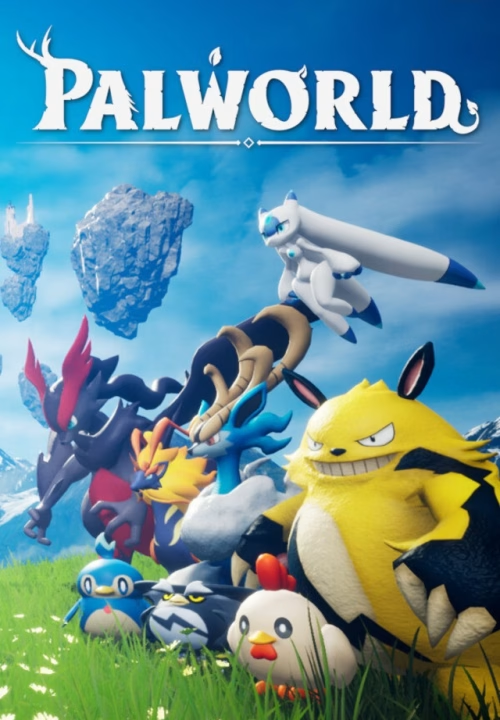
| Platforms | Microsoft Windows |
|---|---|
| Developer | Pocketpair |