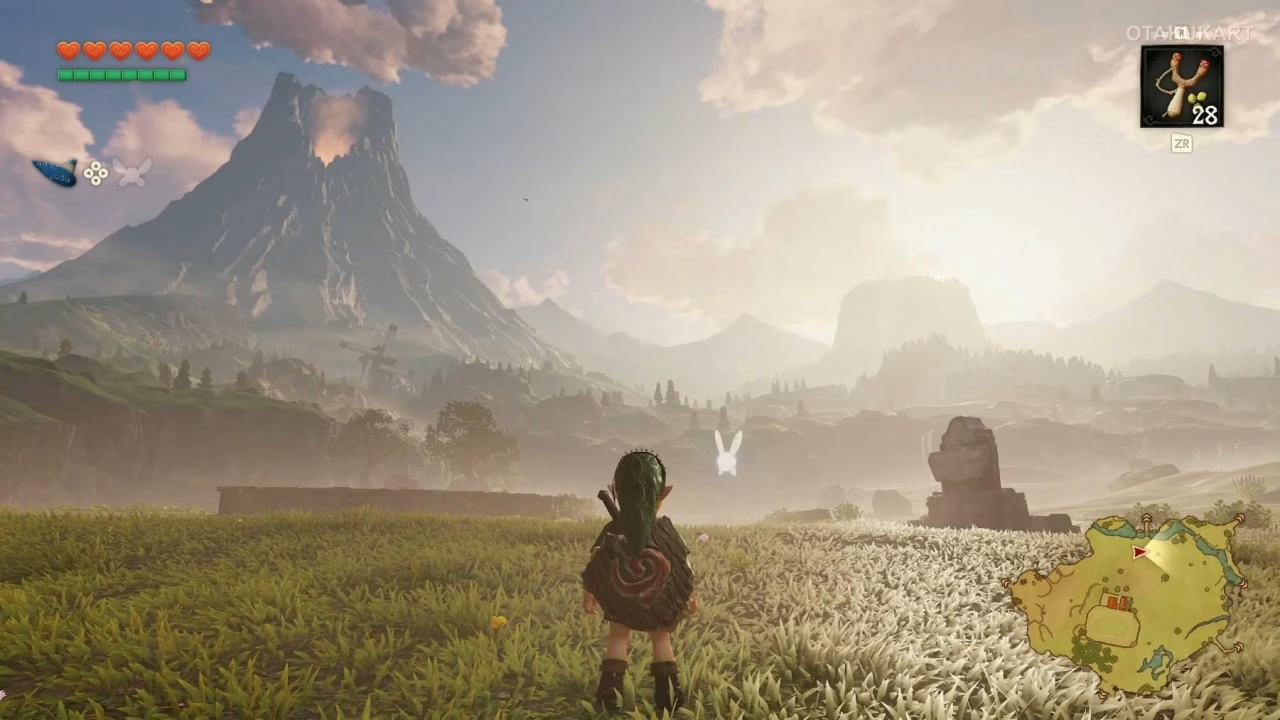
The upcoming The Legend of Zelda: Ocarina of Time remake for Nintendo Switch 2 reportedly uses AMD FidelityFX Super Resolution 1.0 (FSR 1.0) for image upscaling alongside SMAA anti-aliasing. The discovery has attracted attention because Nintendo’s latest console features Nvidia hardware capable of supporting Deep Learning Super Sampling (DLSS), a more advanced image reconstruction technology.
The information comes from the game’s version 1.0.0 Intellectual Property Notices, which reportedly list several third-party technologies included in the software. An entry identifies AMD FSR 1.0, while another mentions an optimised mobile implementation of its Edge Adaptive Spatial Upsampling (EASU) technology. SMAA also appears in the notices.
However, the listing does not establish whether FSR 1.0 is used throughout the game or only in particular rendering situations. Nintendo has not publicly explained its upscaling choices for the remake.
Ocarina of Time Remake’s Software Notices List AMD FSR 1.0 and SMAA
The discovery was highlighted by gaming enthusiast SuperMetalDave64 in a video shared on X. The footage reportedly shows the game’s software menu and its third-party licence information, including references to AMD’s upscaling technology.
AMD introduced FSR 1.0 in 2021 as a spatial upscaling solution. It increases the output resolution of an image rendered at a lower resolution, processing individual frames without relying on previous-frame information.
The technology is relatively inexpensive to implement, making it useful for games that need to balance visual quality and performance across different hardware configurations.
SMAA, or Subpixel Morphological Anti-Aliasing, is another technique listed in the notices. It helps reduce visible jagged edges around objects and environmental details.
Interestingly, the available licence information does not show an Nvidia DLSS entry. However, the absence of a listing alone does not conclusively establish that DLSS is not used, since software notices do not necessarily reveal every rendering technique or when particular technologies are activated.
Why the DLSS Comparison Has Attracted Attention
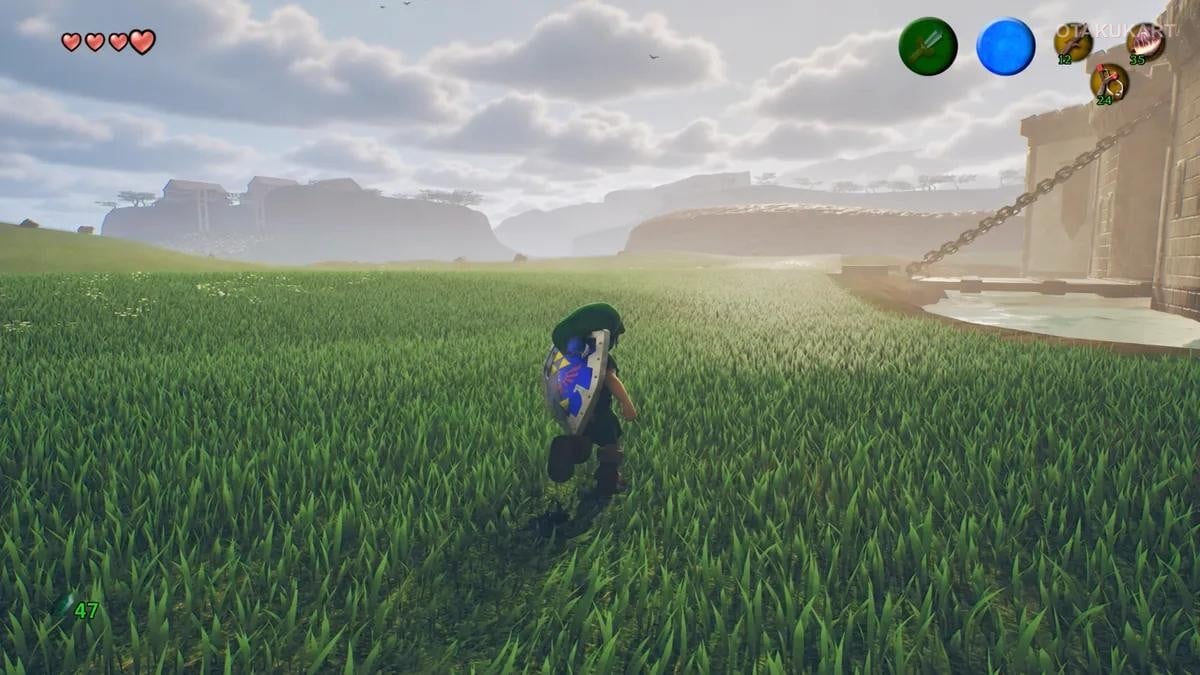
The discussion largely comes from the differences between FSR 1.0 and DLSS.Unlike FSR 1.0, DLSS uses machine-learning-based image reconstruction and can incorporate information from previous frames. This can help preserve fine details and improve image stability, particularly around thin environmental objects such as grass, leaves, and fences.
Nintendo Switch 2 uses a custom Nvidia processor with dedicated Tensor cores that support DLSS. Several third-party games have already demonstrated the technology on the console.
For example, CD Projekt Red confirmed DLSS support for Cyberpunk 2077 across its handheld and docked modes. Hogwarts Legacy also uses DLSS to help deliver its visual presentation on Switch 2.
However, developers do not necessarily have identical rendering pipelines or engine requirements, meaning the availability of DLSS hardware does not guarantee that every game will use it.
Ocarina of Time is not the first major Nintendo Switch 2 release associated with AMD FSR 1.0 and SMAA. Donkey Kong Bananza reportedly uses the same combination.
Digital Foundry’s technical analysis of the 2025 platformer identified FSR 1.0 and SMAA rather than DLSS. The game’s development history and technical requirements have also been discussed as possible factors behind Nintendo’s technology choices.
The Ocarina of Time remake launches on November 5, 2026, exclusively for Nintendo Switch 2. The updated version of the 1998 Nintendo 64 adventure features redesigned visuals, voiced cutscenes, orchestral music, expanded dialogue, and microphone-based ocarina controls.
Until Nintendo or independent technical analysis confirms the game’s rendering resolution and upscaling behaviour, it remains unclear how much FSR 1.0 influences the final image quality. The software notices offer an interesting look at the technology included in the remake, but they do not establish whether players will notice a meaningful difference.
| Release Date | November 21, 1998 |
|---|---|
| Platforms | Nintendo 64, Nintendo GameCube, iQue Player, Nintendo 3DS +1 more |
| Developer | Nintendo EAD |
| Director | Eiji Aonuma Yoshiaki Koizumi |
| Writer / Narrative | Nintendo EAD Toru Osawa |