Santa Monica Studio has revealed bold new details about God of War Laufey, and one blunt quote from its creative leadership is already shaping how fans view the game. In an interview with IGN, the studio’s creative head described the gods inhabiting the game’s afterlife setting in striking terms:
“They’re all a**holes.”
That statement is not just for shock value. It captures the core idea behind Everywhen, a new domain that serves as the backdrop for the upcoming title. Instead of a structured pantheon, this world brings together powerful figures from multiple mythologies and forces them into constant conflict.
The Everywhen Turns Gods Into Rivals
The Everywhen is introduced as an afterlife unlike anything seen in previous God of War entries. Rather than a peaceful resting place or a hierarchical divine realm, it is described as a volatile environment where gods are trapped together.
To explain the concept further, the developer compared it to
“a bunch of billionaires on an island,”
each fighting for dominance. The analogy highlights a key theme of the game: power without restraint leads to chaos. When every character has immense strength and authority, cooperation breaks down, and conflict becomes inevitable.
This idea reframes how mythology is used in the series. Instead of focusing on individual pantheons like Greek or Norse, God of War Laufey merges multiple mythologies into a single space, creating new tensions and unpredictable encounters.
A Darker Direction for the Franchise
The shift in setting signals a broader change in tone for the franchise. Earlier games explored structured mythological worlds where gods ruled over defined domains. In contrast, Everywhen removes that structure entirely.
According to the IGN interview, the gods in this realm have a
“terrible relationship with power,”
which leads to constant infighting. This framing positions the Everywhen almost like a prison, where powerful beings are forced to coexist without any governing system.
The result is a world driven by ego, rivalry, and survival rather than order. This approach allows the story to explore deeper themes about power and its consequences, pushing the series into more complex territory.
New Mythologies Expand the Conflict
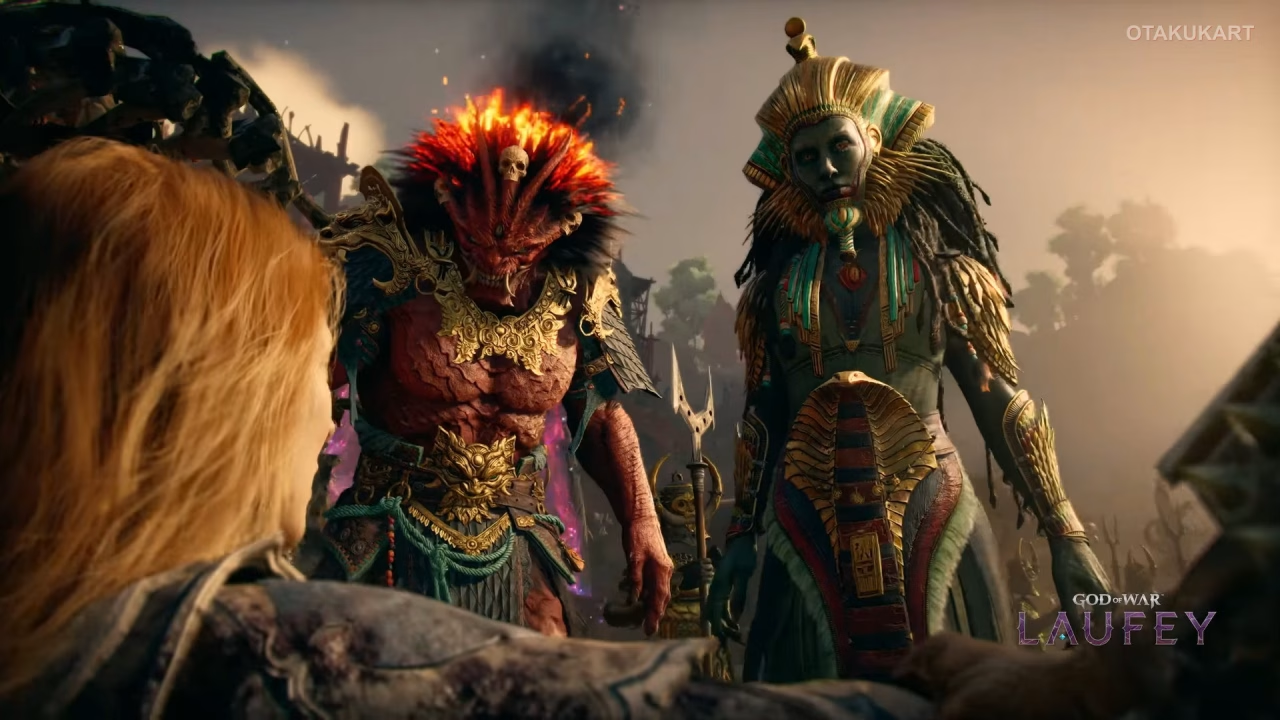
The reveal footage already showcases how this new direction plays out through its characters. Figures like Sekhmet, an Egyptian goddess associated with destruction and vengeance, and Begtse, a Mongolian god of war, highlight the game’s multi-mythology approach.
Their inclusion suggests that God of War Laufey is not limited to a single cultural framework. Instead, it builds a shared universe where different mythologies intersect, creating opportunities for unique rivalries and alliances.
Game Director Ariel Lawrence emphasized the importance of these encounters, noting that characters like Sekhmet carry a strong presence and authority. The goal is to create moments where these powerful figures clash in ways that feel both intense and meaningful.
Faye’s Role in a World Without Order
At the center of this chaotic setting is Faye, who takes over as the game’s protagonist. Unlike Kratos, whose journey often involved steering structured systems of power, Faye enters a world where no such systems exist.
Lawrence further explained in the interview that shifting the focus to Faye is not a departure from the series but an expansion of it. By exploring her story, the developers aim to provide a fresh perspective while still connecting to the broader narrative established in earlier games.
This perspective becomes especially important in Everywhen, where Faye must navigate a terrain defined by instability and conflict. Her abilities, including magic tied closely to nature, play a key role in how players interact with this new environment.
Despite its new setting and protagonist, God of War Laufey remains closely tied to the existing timeline. The developers confirmed that the story runs parallel to the events of God of War (2018) and God of War Ragnarök.
The creative team emphasized that this is not a side story but a continuation of the same universe. This approach ensures that the events in Everywhen have lasting implications for the franchise as a whole.