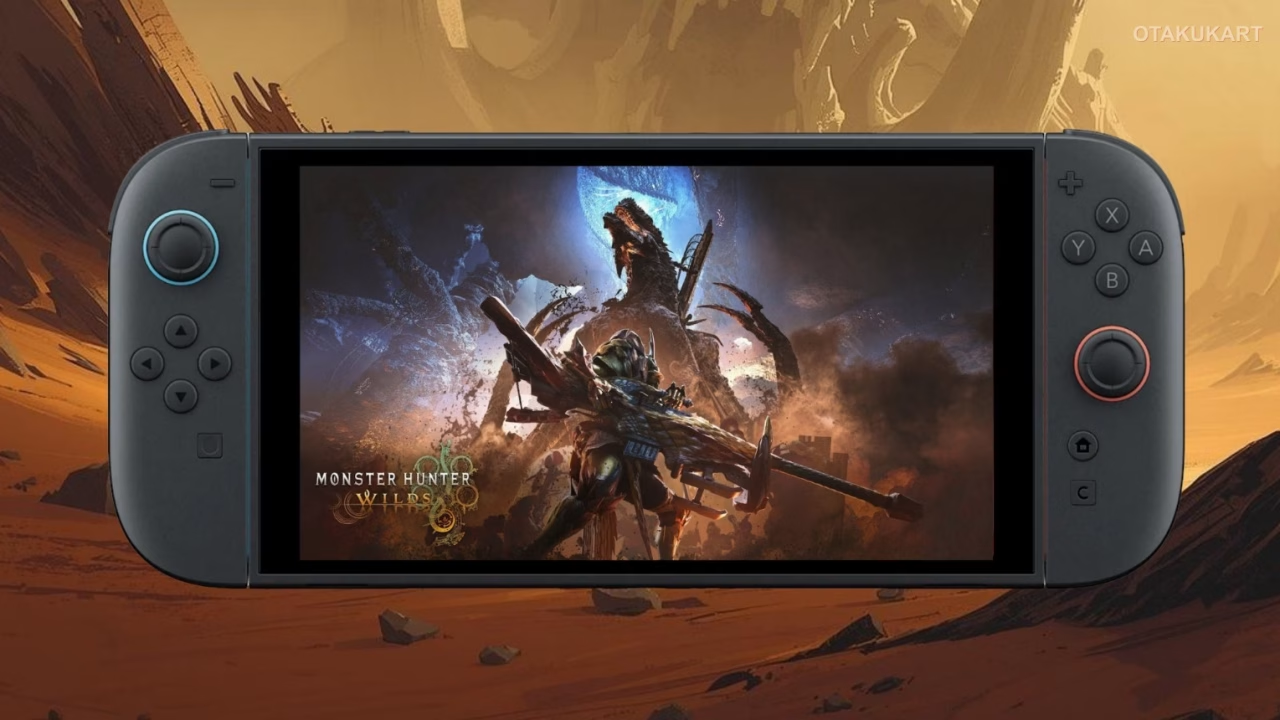
Monster Hunter Wilds is showing promising performance on the Nintendo Switch 2, with its latest demo delivering a largely stable 30 frames per second in its quality mode. Despite the technical demands of Capcom’s open-world hunting game, the portable console appears capable of providing a consistent experience through carefully selected graphical compromises and Nvidia’s DLSS upscaling technology.
The findings come from Digital Foundry’s technical analysis, which examined the Switch 2 demo against the Xbox Series S and PlayStation 5 versions. The comparison suggests that Capcom has prioritized stable performance and image reconstruction rather than attempting to match the more powerful consoles feature for feature.
The results are particularly encouraging because Monster Hunter Wilds has presented significant performance challenges on other platforms. Its Switch 2 adaptation demonstrates how modern upscaling techniques and platform-specific optimizations can help demanding games run on less powerful hardware.
MONSTER HUNTER WILDS OFFERS TWO GRAPHICS MODES ON SWITCH 2
When played in docked mode, the Switch 2 demo offers quality and performance options, alongside a setting that locks the frame rate at 30 FPS. The quality mode is particularly impressive, maintaining a near-constant 30 FPS throughout the tested gameplay, with only occasional single-frame drops during cutscene transitions.
The performance mode makes different compromises to deliver higher frame rates. Without frame generation, performance reportedly fluctuates between approximately 40 and 55 FPS, while internal rendering resolution falls to around 600p and reflections are reduced.
Handheld mode takes a different approach, using an internal resolution of approximately 432p before upscaling the image to fit the console’s 1080p display. Shadows receive further reductions, and screen-space reflections are disabled to accommodate the handheld power profile.
Despite these adjustments, the demo reportedly maintains a stable 30 FPS when the frame-rate limit is enabled. Unlocked performance is less consistent, with visible judder potentially affecting the experience because system-level variable refresh rate support does not adequately resolve the uneven frame delivery.
SWITCH 2 VISUALS COMPARE FAVORABLY WITH XBOX SERIES S
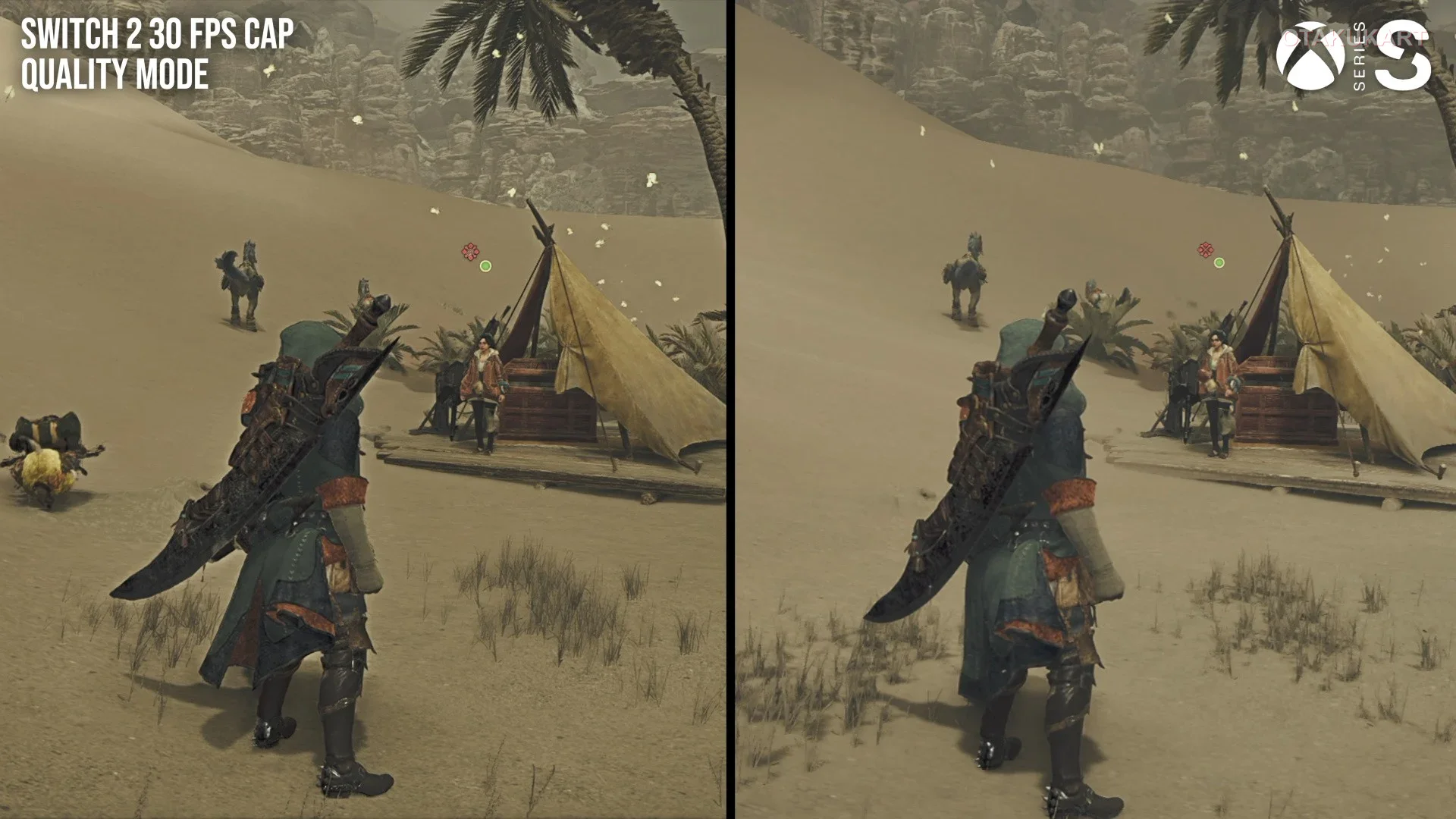
The Switch 2 version also delivers some unexpected visual advantages over the Xbox Series S edition. According to Digital Foundry’s analysis, textures on clothing, books, and environmental surfaces can appear sharper on Nintendo’s hardware. The Switch 2 quality mode also retains screen-space reflections on reflective surfaces, a feature missing from the Series S version.
A major factor is Nvidia DLSS, which reconstructs the image from a lower internal resolution. The docked quality mode renders at approximately 648p internally, but its upscaled image can appear cleaner than the Series S version’s output, which relies on temporal anti-aliasing. The Switch 2 image still exhibits some shimmering in motion, particularly around fine details such as hair.
These advantages come with compromises. Environmental shadows are reduced or absent in certain areas, distant foliage lacks animation, and some characters animate at lower rates when far from the camera. Clothing movement, hair rendering, and model complexity have also been reduced.
The PlayStation 5 version retains advantages in geometry, texture resolution, and visual effects. However, Digital Foundry also noted shortcomings in its FSR 1 upscaling, which can produce harsh sharpening and noticeable edge shimmer. The comparison illustrates that image quality depends on more than rendering resolution alone.
MONSTER HUNTER WILDS SWITCH 2 RELEASE LOOKS PROMISING
The demo suggests that Capcom has made meaningful progress in adapting its RE Engine to Nintendo’s hybrid console. Its stable frame pacing, DLSS reconstruction, and flexible docked settings provide a stronger technical foundation than some earlier demanding ports.
However, the findings cover only the demo, so performance during larger hunts, busier environments, and more demanding combat encounters remains to be confirmed in the full release. Monster Hunter Wilds is scheduled to launch on Nintendo Switch 2 on December 4, 2026.
If Capcom maintains the demo’s performance consistency throughout the full game, Monster Hunter Wilds could become one of the Switch 2’s more impressive third-party conversions. For players prioritizing smooth gameplay, the capped 30 FPS quality mode currently appears to be the most dependable option.
| Platforms | PC, PlayStation 5, Xbox Series X/S |
|---|---|
| Developer | Capcom |
| Director | Yuya Tokuda |