As Final Fantasy IV celebrates its 35th anniversary, Square Enix has shared new behind-the-scenes details about the game’s development through a special interview featuring Final Fantasy IV director Takashi Tokita and Final Fantasy X producer Yoshinori Kitase.
One of the biggest revelations is that the beloved RPG was never originally intended for the Super Nintendo. Instead, development began with the Nintendo Entertainment System (NES) in mind before an unexpected change shifted the project to the SNES.
The interview offers a rare look at how the hardware transition influenced the game’s design, visuals, and storytelling, while also highlighting the technical challenges Square’s developers faced during one of the most important periods in the franchise’s history. The interview was published by Square Enix.
Final Fantasy IV’s move from NES to SNES changed the game’s direction
Tokita revealed that Final Fantasy IV entered development in 1989 and had a significantly longer production cycle than most games of that era. He explained that the title initially targeted the NES before plans changed.
“When the project kicked off, it was originally intended for the NES, but I think it ended up being developed for the SNES instead due to some unexpected changes,”
Tokita said during Square Enix’s anniversary interview.
According to Kitase, by the time he joined the project in 1990, development had already shifted to Nintendo’s new console. He recalled that Final Fantasy creator Hironobu Sakaguchi was impressed after seeing demonstrations of the SNES’s Mode 7 technology at a trade show and wanted the team to take advantage of its advanced visual effects.
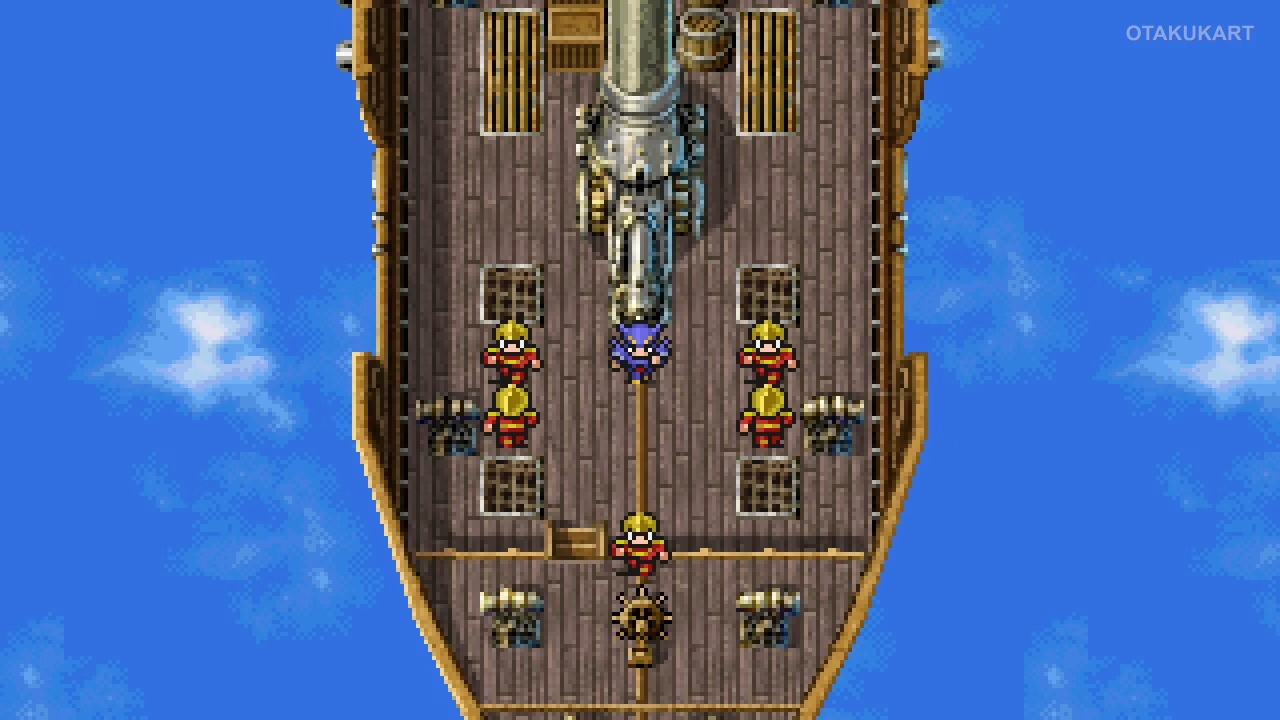
Kitase explained that this decision directly inspired the game’s memorable opening airship sequence, which showcased the SNES’s ability to rotate and scale backgrounds—something impossible on the original NES hardware.

New hardware created fresh opportunities—and new limitations
Although the SNES offered a major leap in power, Tokita said it introduced its own technical hurdles. While developers gained access to a richer color palette, memory limitations forced the team to carefully decide which assets deserved the highest visual quality.
Tokita recalled that only select elements—including the airship, the final dungeon, and Zeromus—were allowed to use all sixteen colors after receiving approval from Sakaguchi. He also revealed that storage limitations had an even greater impact on the game’s story.
After expanding Sakaguchi’s original scenario and writing the in-game dialogue, Tokita said the team discovered they could only fit about one-fourth of the planned script into the final ROM because of memory constraints.
The interview also highlighted the difficulties of early game development, with Tokita and Kitase describing how developers manually managed memory addresses and sometimes accidentally overwrote each other’s work due to the lack of modern development tools.
Reflecting on the project, Tokita said Final Fantasy IV represented a culmination of ideas introduced in the franchise’s earlier entries while taking advantage of a new generation of hardware. He explained that the team intentionally combined the dramatic storytelling of Final Fantasy II, elements inspired by Final Fantasy III, and the capabilities of the SNES to create a game that left a lasting impression on players.
Today, Final Fantasy IV remains available on Nintendo Switch, Nintendo Switch 2, PlayStation, Xbox, PC, and mobile devices through the Final Fantasy Pixel Remaster collection.