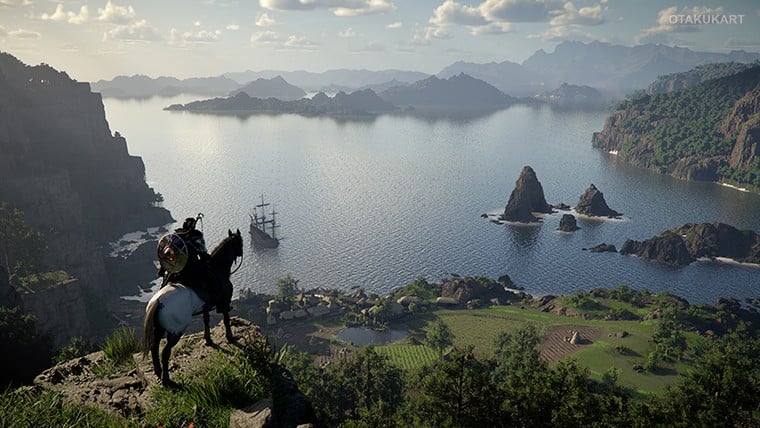
Pearl Abyss developers have revealed the philosophy behind one of Crimson Desert’s most ambitious features: building the world of Pywel so that distant landmarks are not simply visual decoration. Speaking during a Gamescom Dev 2026 presentation, Environment Artist Geuntae Ahn explained that the team wanted players to trust what they saw on the horizon and believe that almost every visible destination could become part of their journey.
According to Ahn, that sense of trust became one of the most valuable achievements of the development process.
“If you can see it in the distance, you should be able to go there,”
he said while discussing the creation of Pywel. Pearl Abyss had previously confirmed its Gamescom Dev sessions would explore how the studio built its massive open world using its proprietary technology.
Crimson Desert’s World Was Designed for Exploration, Not Just Beauty
Ahn explained that Pearl Abyss did not want Pywel’s environments to function merely as impressive backdrops. Instead, the studio wanted the environment itself to become meaningful content that encourages exploration and guides players toward new locations.
“We didn’t want our environment to just be backdrops; we wanted our environment to be content.”
The team reportedly examined landmarks from very different distances, including from roughly one kilometer away and as close as 10 meters. A location needed to work as a recognizable point on the horizon while also offering enough detail and purpose once players finally reached it.
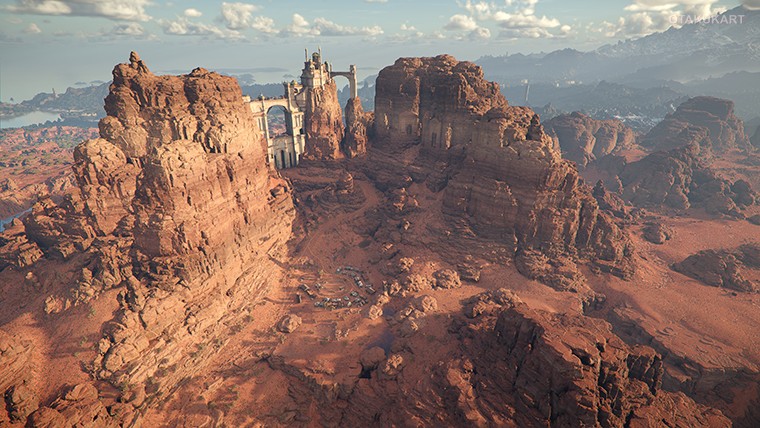
That approach created a difficult balance between visual realism and gameplay. As Ahn put it,
“Beauty and explorability are not the same thing.”
The developers discovered that creating a beautiful environment was not enough if players could not comfortably navigate through it or understand where they could go next.
The developers also had to solve consistency problems across the enormous open world. Hundreds of separate areas needed to feel connected despite being created by different teams, while the studio’s BlackSpace Engine continued evolving during development.
Pearl Abyss said its Gamescom Dev sessions would cover environmental design, automated production systems, real-world terrain references, procedural terrain generation, and biome-based placement tools. The goal was to create a world with a strong sense of scale and density without losing artistic control or making exploration difficult.
For Crimson Desert, making players believe in the horizon became more important than simply filling the screen with impressive scenery. The developers’ solution was to make Pywel’s distant mountains, structures, and landmarks feel like genuine destinations, turning the open world itself into part of the gameplay experience.

| Platforms | PC, PlayStation 5, Xbox Series X/S |
|---|---|
| Developer | Pearl Abyss |