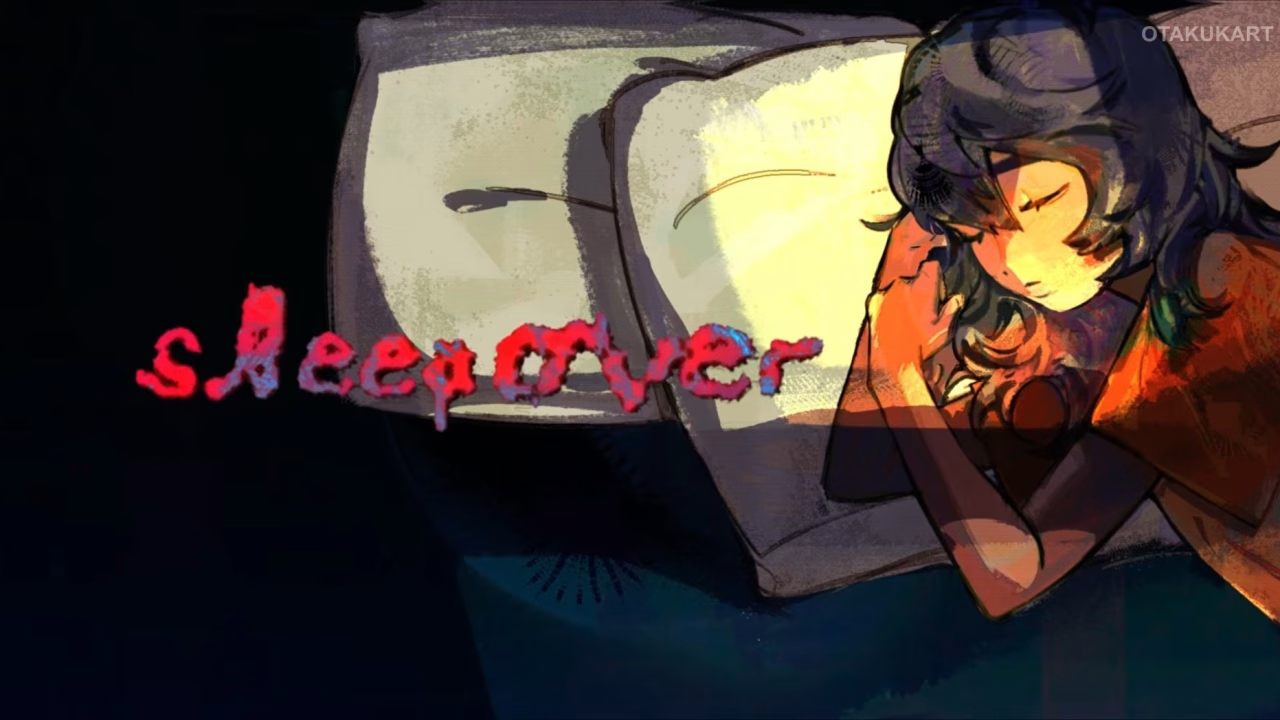
Sleepover takes an unusual approach to cosmic horror. Instead of focusing on sprawling alien worlds or incomprehensible monsters, the upcoming visual novel narrows its attention to a single apartment and the final night shared by what may be the last two humans alive. Developed by KittyWampus, the game follows Yuna, a young woman left alone after humanity mysteriously disappears, whose quiet isolation is interrupted by the arrival of a mysterious girl named Fermi.
That restrained premise is exactly what drew director Skyler Zeng toward the project.
“The image of two girls alone was most likely the first thought that came to mind,”
Zeng shared in a written interview provided to OtakuKart. Rather than telling another end-of-the-world story driven by spectacle, the team wanted to explore how meaningful human connections become when time itself has nearly run out.
The result is a character-driven narrative where memories, personal fears, and everyday objects reveal the emotional state of its protagonist while slowly uncovering the truth behind humanity’s disappearance. Ahead of Sleepover’s Gamescom 2026 showcase, Zeng spoke about the game’s origins, its intimate take on cosmic horror, and the emotional challenges behind bringing Yuna’s story to life.
Skyler Zeng discusses Sleepover’s emotional storytelling and cosmic horror inspirations
OtakuKart: Where did Sleepover begin for you? Was the first thing you knew about it the image of two girls in an apartment, or the idea of everyone on Earth vanishing at once?
Skyler Zeng: It’s hard to remember for sure, but the image of two girls alone was most likely the first thought that came to mind. I remember wanting to highlight the power of human relationships, and the idea of getting along with a stranger at the end of the world.
OtakuKart: Naming the girl who arrives after humanity disappears “Fermi” points straight at the paradox and the silence that comes with it. How much of that framing do you want players to pick up on, and how did it shape who she is beyond being Yuna’s companion for the night?
Skyler Zeng: I think it’s great if players pick up on the name and begin to think about what it means for the game’s themes and characters. Knowledge of the paradox or meaning of the word isn’t at all necessary, but players who know may have a subtly improved experience.
OtakuKart: Cosmic horror usually works through scale, vast forces that don’t notice us. Sleepover compresses that into one apartment over one night. What does the genre gain from that compression, and what was hardest to give up by working so small?
Skyler Zeng: The fact that the game takes place in a very closed and intimate setting helps the themes present with cosmic horror. For example, you mentioned that it usually works through scale. There’s a big world outside of Yuna’s door, and it will seem ever bigger now that she’s the only human left on Earth. Taking this a step further, there is an even bigger universe if you think outside our own planet. This causes Yuna to feel even more insignificant, and infinitely, cosmically alone. The apartment is the only thing shielding her from this reality.
The hardest thing to design around is finding ways to keep the apartment interesting since it is quite small for an explorable environment that players can walk around in. The answer to this was to give deeper interactions with elements of the apartment, and include lots of items that are rich with family history.
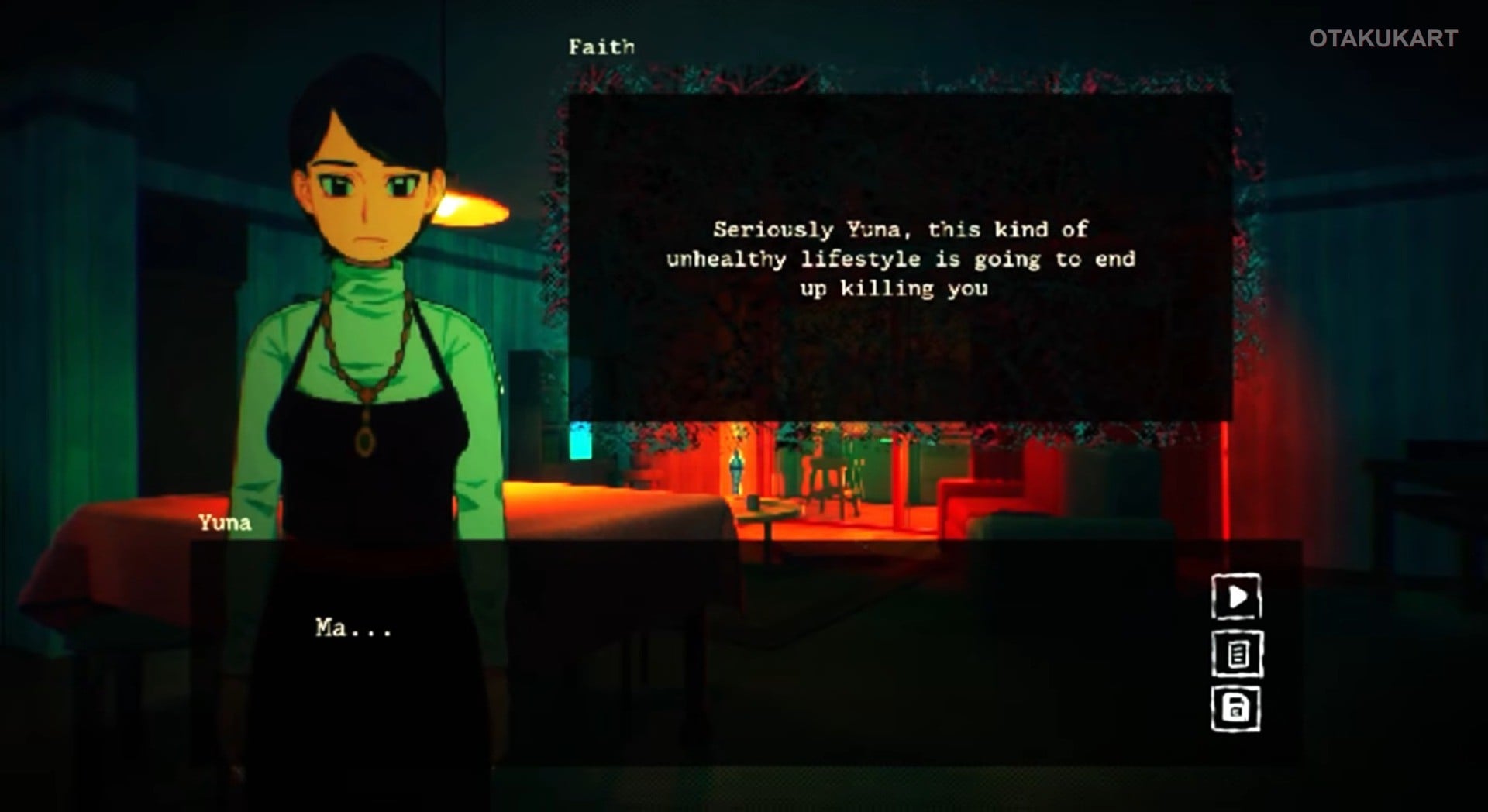
OtakuKart: Interacting with objects around the apartment is the player’s main action, and the reward is emotional rather than mechanical. How do you decide what a single object should reveal about Yuna, and how do you keep players wanting to examine the next one?
Skyler Zeng: Yuna is a very complex character, and so there are a lot of ways to build on her feelings and emotions while still holding back information that are saved for larger reveals. It also helps that Yuna is a sentimental person, and so she has deep connections with a lot of the objects around the apartment. She may have a lot to say about something that may be seemingly mundane. Most of these interactions are optional, meaning players can engage with them if they want to learn more about her, but it is not necessary to read through all her thoughts and ramblings in order to complete the main story.
OtakuKart: Telling a player not to go inside a room guarantees they will think about nothing else. How did you design around that certainty, and what does that door need to deliver when it finally opens?
Skyler Zeng: It’s always good to have an established element of mystery in a story like this, and that’s what the presence of the door gives to Sleepover. Whatever it delivers has to be satisfying since it is one of the game’s central secrets. As for what that is, you’ll just have to play and find out!
OtakuKart: The Steam page is upfront about depictions of depression, anxiety, and suicide, and at the same time the game asks players to build good memories inside an ending that is already decided. Where did you draw the line between portraying Yuna’s decline honestly and letting it become a horror device, and who did you have in the room while writing those scenes?
Skyler Zeng: Yuna is put in this incredibly troubling situation, so it makes sense for her headspace to reflect that. Her decline is directly tied to the horrors she experiences, the main one being her circumstance itself which is already immensely terrifying. I work with another member of the team (Ashley) when writing scenes to achieve this to the best of our ability.
Sleepover is currently in development by KittyWampus and is available to wishlist on Steam ahead of its future release.