
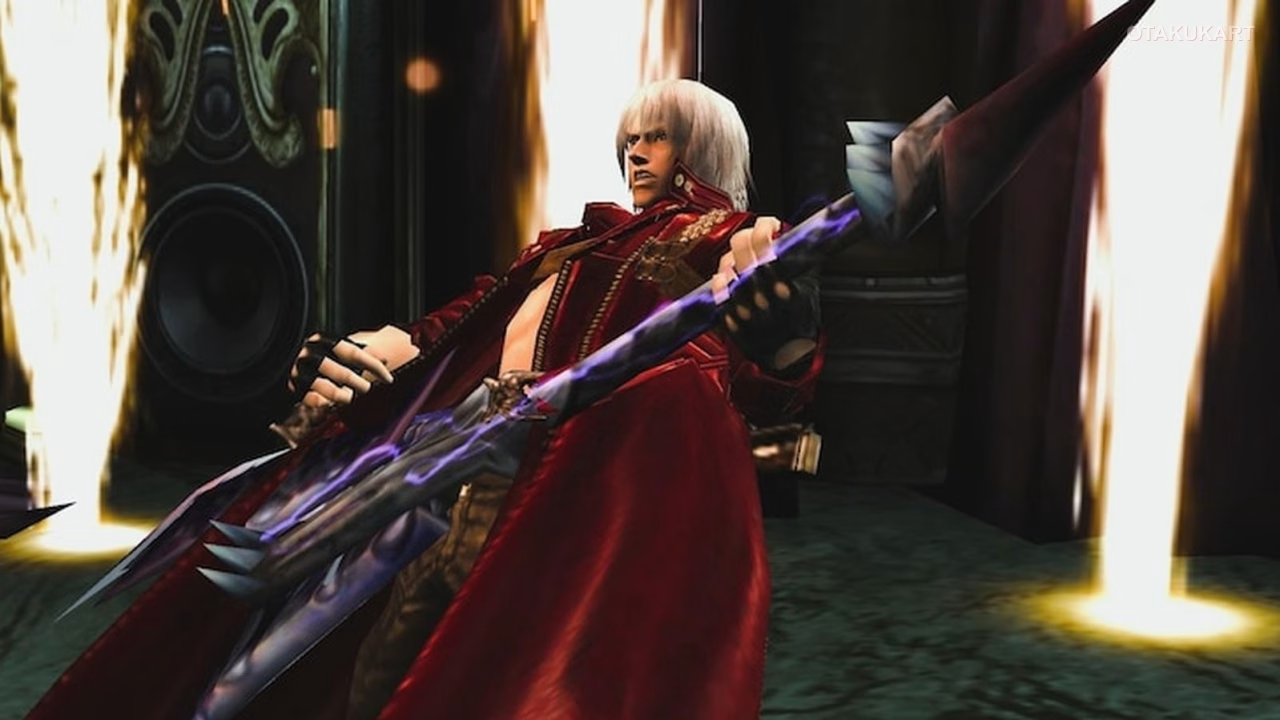
One of gaming’s most stylish action franchises almost had a very different identity. Devil May Cry, known today for its fast-paced combat and over-the-top style, actually began as a project tied to Capcom’s survival horror series Resident Evil.
The revelation comes from series creator Hideki Kamiya, who recently revisited the origins of the game and how it transformed during development. Speaking via Clover Studio’s official site, Kamiya explained that the project initially started with a clear goal: create another entry in the highly successful Resident Evil franchise.
At the time, Resident Evil had already become a global hit, and Capcom was eager to expand the series on newer hardware. However, what began as a continuation of survival horror gradually evolved into something entirely different.
From Survival Horror to Stylish Action
According to Kamiya, the shift happened naturally during development. As the team worked on the project, they began experimenting with new ideas that didn’t quite fit within the traditional Resident Evil formula.
“A lot of people know the story behind ‘Devil May Cry’ (2001), but that one started off as a mandate to create another entry for ‘Resident Evil,’”
Kamiya said.
He explained that the move to PlayStation 2 allowed the team to explore new possibilities, which led to a wave of creative experimentation.
“We started coming up with all sorts of new concepts and things we wanted to build on, and that eventually morphed into ‘Devil May Cry.’”
This creative freedom pushed the game away from slow-paced horror and toward a more action-driven experience. Instead of focusing on tension and limited resources, the team leaned into fluid combat, stylish movement, and a more energetic tone.

Why the Project Split From Resident Evil
As development continued, it became clear that the project no longer aligned with what defined Resident Evil. The series was built around survival mechanics, horror atmosphere, and careful pacing, while the new ideas being introduced emphasized speed, spectacle, and player expression.
Rather than forcing the project back into the Resident Evil mold, Capcom made the decision to spin it off into a new franchise. That decision allowed the team to fully embrace the direction they were exploring without being restricted by existing expectations.
The result was Devil May Cry, released in 2001 for PlayStation 2, which introduced players to a completely new style of gameplay. Its emphasis on combos, ranking systems, and stylish execution would go on to influence an entire genre of action games.
The transformation of Devil May Cry is now seen as one of the most important pivots in Capcom’s history. By allowing the project to evolve rather than forcing it to fit an established formula, the company created a new franchise that stood alongside its biggest hits.
At the same time, Resident Evil continued to evolve in its own direction, eventually incorporating more action elements in later entries. In a way, the split allowed both series to grow independently, each exploring different aspects of gameplay.
Kamiya’s insight highlights how experimentation during development can lead to unexpected results, sometimes creating entirely new genres in the process.
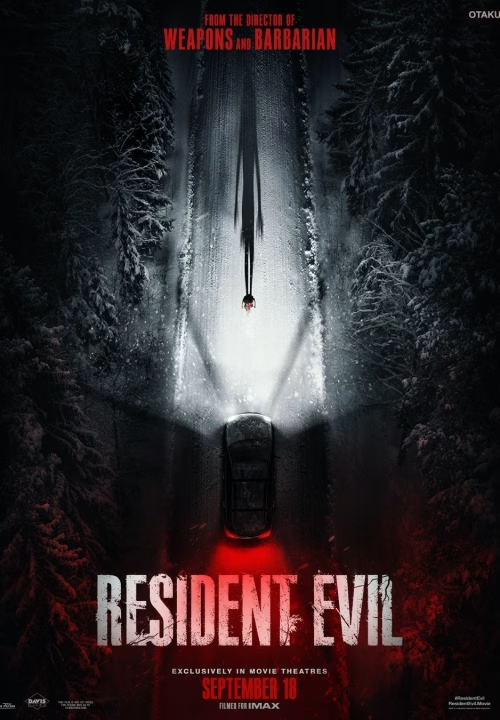
| Release Date | September 18, 2026 |
|---|---|
| Studio | Columbia Pictures, Constantin Film, TriStar Pictures |
| Director | Zach Cregger |
| Writer(s) | Zach Cregger, Shay Hatten |