Anime is often associated with colorful adventures, comedy, and family-friendly entertainment, but the medium has long been home to stories created specifically for mature audiences. Some of the most critically acclaimed anime films explore complex themes such as war, loss, identity, mental health, morality, and the consequences of human ambition. These are movies that challenge viewers emotionally and intellectually, proving that animation can be just as powerful as live-action cinema.
From influential classics that helped shape the anime industry to modern masterpieces that continue to earn worldwide acclaim, these are the 18 best R-rated anime movies that showcase the artistic depth and storytelling potential of Japanese animation.
1. Perfect Blue (1997)
At a time when celebrity culture and online obsession dominate everyday life, few films feel as unsettlingly relevant as Perfect Blue. Directed by Satoshi Kon in his feature debut, the psychological thriller follows Mima Kirigoe, a successful pop idol who leaves her music career behind to become an actress. What begins as a bold career move slowly turns into a terrifying descent as she struggles to separate reality from illusion.
Rather than relying on jump scares, the film creates tension through psychological uncertainty. This storytelling approach keeps audiences engaged until the final moments and has inspired countless discussions since its release.
The movie has earned lasting recognition beyond the anime industry. Many critics and film scholars have pointed to its influence on Darren Aronofsky’s Black Swan, particularly its exploration of identity, fame, and mental collapse. Today, its themes surrounding parasocial relationships, internet harassment, and the pressure of maintaining a public image feel even more meaningful than they did in 1997
2. Grave of the Fireflies (1988)
Few films capture the human cost of war with the honesty and emotional weight found in Grave of the Fireflies. Directed by Isao Takahata, this Studio Ghibli classic tells the heartbreaking story of siblings Seita and Setsuko as they struggle to survive during the final months of World War II after the firebombing of Kobe. Instead of focusing on battlefield action, the film presents war through the eyes of innocent children whose greatest enemies become hunger, loneliness, and the loss of hope.
The emotional power of the story comes from its realism. There are no larger-than-life heroes or clear villains. Every tragedy stems from the devastating consequences of war and the difficult choices ordinary people are forced to make. The relationship between the siblings remains the emotional heart of the film, making every moment feel deeply personal.
Although Studio Ghibli is widely known for fantasy adventures such as My Neighbor Totoro and Spirited Away, this film showcases the studio’s ability to tell grounded, emotionally devastating stories. Critics have consistently praised its historical authenticity, subtle direction, and unforgettable ending, making it one of the most respected anti-war films ever created.
3. Akira (1988)
Long before cyberpunk became a global phenomenon, Akira redefined what animated films could achieve. Directed by Katsuhiro Otomo and adapted from his own manga, the film transports viewers to Neo-Tokyo, a futuristic city shaped by political corruption, social unrest, and scientific experimentation. At the center of the story are teenage biker Kaneda and his childhood friend Tetsuo, whose unexpected psychic powers trigger events that threaten the entire city.
The film stands out because of its ambitious storytelling and extraordinary hand-drawn animation. Every frame is packed with intricate details, from towering cityscapes to explosive action sequences that continue to impress modern audiences. Even decades later, many animators consider it one of the greatest technical achievements in animation history.
Beyond its stunning visuals, Akira explores themes of government control, military power, youth rebellion, and the dangers of unchecked scientific ambition. Its willingness to embrace complex political ideas and disturbing body horror helped distinguish it from traditional animated features aimed at younger viewers.
The influence of Akira extends far beyond Japan. Many Hollywood filmmakers, game developers, and artists have credited it as a major inspiration for their work, while its iconic motorcycle slide remains one of the most recreated scenes in popular culture. Modern 4K theatrical re-releases continue attracting large audiences, proving that their appeal has not faded.
4. Ghost in the Shell (1995)
Technology continues to reshape everyday life, making Ghost in the Shell feel more relevant with each passing year. Directed by Mamoru Oshii, this influential science fiction film follows Major Motoko Kusanagi, a cybernetic government agent investigating a mysterious hacker known as the Puppet Master. While the story unfolds as a futuristic crime investigation, its greatest strength lies in the philosophical questions it asks about identity, consciousness, and what it truly means to be human.
In a future where memories can be manipulated, and bodies can be replaced with advanced cybernetic enhancements, the film challenges viewers to consider whether a person’s humanity comes from their physical form, their experiences, or something deeper. These ideas remain remarkably timely in an era shaped by artificial intelligence, digital identities, and rapidly advancing technology.
Visually, Ghost in the Shell combines detailed animation with atmospheric cityscapes that create a believable cyberpunk world. Its slower pacing allows audiences to absorb both the action and the philosophical conversations, rewarding viewers who enjoy stories that encourage reflection rather than offering simple answers.
The film has had an enormous impact on global cinema. The Wachowskis openly acknowledged its influence while developing The Matrix, and many later science fiction films borrowed elements from its visual style and storytelling approach. It continues to be studied by filmmakers and critics interested in philosophical science fiction.
5. Paprika (2006)
Dreams and reality collide spectacularly throughout Paprika, one of Satoshi Kon’s most imaginative works. Released in 2006, the film follows psychiatrist Atsuko Chiba, who uses an experimental device that allows therapists to enter patients’ dreams. When the technology is stolen, dreams begin spilling into the real world, creating a surreal mystery where imagination and reality become impossible to separate.
Unlike traditional psychological thrillers, Paprika embraces vibrant colors, constantly shifting environments, and dreamlike visuals that transform ordinary locations into unforgettable spectacles. Every sequence introduces creative imagery that keeps viewers guessing while reflecting the emotional and subconscious struggles of its characters.
Beneath its dazzling animation, the story explores serious ideas about technology, identity, creativity, and the hidden desires people suppress in everyday life. Rather than providing simple explanations, the narrative encourages audiences to interpret its symbolism, making each viewing reveal new details and meanings.
The film’s visual creativity has earned widespread praise from critics and filmmakers. Christopher Nolan has acknowledged its influence on Inception, particularly in the way dreams are portrayed as immersive worlds where reality becomes increasingly uncertain.
6. Millennium Actress (2001)
Some films tell a story, while others explore how memories shape the stories people tell themselves. Millennium Actress is a perfect example of the latter. Directed by Satoshi Kon, the film follows a documentary filmmaker and his cameraman as they interview Chiyoko Fujiwara, a retired movie star who disappeared from the public eye years earlier. As Chiyoko recalls her life, her personal memories blend seamlessly with scenes from the films she once acted in, making it increasingly difficult to separate fiction from reality.
Instead of relying on traditional flashbacks, the narrative moves effortlessly across different time periods, historical events, and movie genres. One moment the characters are in feudal Japan, and the next they are in a futuristic science fiction setting, yet every transition feels natural. This creative storytelling reflects how memories are often shaped by emotions rather than facts.
At its heart, the film is about love, ambition, and the lifelong pursuit of a dream. Chiyoko spends decades chasing a man she briefly met in her youth, and that search quietly influences every decision she makes throughout her life. Rather than focusing on whether she succeeds, the story asks whether the journey itself gives life its meaning.
Although Perfect Blue and Paprika usually receive more attention, many critics and longtime anime fans consider Millennium Actress one of Satoshi Kon’s finest achievements. It regularly appears in recommendations for viewers seeking emotionally mature animated films with unconventional storytelling. More than two decades after its release, the film continues to earn praise for its emotional depth, elegant direction, and timeless exploration of memory and identity.
7. Tokyo Godfathers (2003)
Season 2 introduces new characters while expanding the mythology surrounding the Oni and Momotaro factions. The Nikko Kegon Falls Arc promises larger-scale battles, stronger enemies, and major revelations that add greater depth to the story. These developments are expected to raise the stakes considerably while creating more opportunities for the returning cast to grow and evolve.
As their search unfolds, each character is forced to confront painful memories, broken relationships, and the mistakes that led them to where they are. Instead of judging its protagonists, the film treats them with empathy, presenting them as flawed but deeply human individuals trying to find redemption.
The movie balances emotional drama with humor, creating a story that feels hopeful without ignoring difficult realities. Themes of poverty, family, addiction, identity, and forgiveness are handled with remarkable sensitivity, making every emotional moment feel genuine. The chemistry between the three main characters also gives the film warmth that sets it apart from many other mature dramas.
8. Jin-Roh: The Wolf Brigade (1999)
Political thrillers are rare in animation, but Jin-Roh: The Wolf Brigade delivers one of the genre’s strongest examples. Written by Mamoru Oshii and directed by Hiroyuki Okiura, the film takes place in an alternate version of postwar Japan where a heavily armed government force maintains order through fear and violence. The story centers on Kazuki Fuse, a member of an elite counterterrorism unit whose life changes after a failed mission leaves him emotionally shaken.
While recovering from the incident, Fuse develops a relationship with a young woman connected to an underground resistance movement. Their growing bond forces him to question his loyalty, personal morality, and the brutal system he serves. Rather than offering simple heroes and villains, the film explores how authoritarian governments manipulate individuals through fear, propaganda, and obedience.
The animation favors realism over spectacle, using subtle facial expressions, carefully choreographed action, and grounded environments to strengthen its tense atmosphere. Every confrontation feels meaningful because the emotional conflicts are just as important as the physical ones.
One of the film’s defining features is its use of the Little Red Riding Hood fairy tale as a recurring symbol, reinforcing themes of innocence, manipulation, and sacrifice. These literary references add another layer of meaning without distracting from the central narrative.
9. In This Corner of the World (2016)
War stories often focus on large battles and historical events, but In This Corner of the World takes a far more personal approach. Directed by Sunao Katabuchi, the film follows Suzu Urano, a cheerful young woman who moves to Kure after marriage during the final years of World War II. As she adjusts to her new family and everyday responsibilities, the realities of war slowly begin to reshape the peaceful life she hopes to build.
Much of the film celebrates ordinary moments such as preparing meals, sketching, caring for loved ones, and finding happiness in small routines. These quiet scenes create a powerful emotional foundation, allowing viewers to connect deeply with the characters before the conflict reaches its devastating climax.
Rather than rushing toward tragedy, the film patiently illustrates how war gradually changes every aspect of daily life. Food shortages, air raids, and growing uncertainty become increasingly common, making each loss feel personal instead of distant. This careful pacing gives the story remarkable emotional impact without relying on excessive melodrama.
Although comparisons with Grave of the Fireflies are common, the two films tell very different stories. While both examine the human consequences of World War II, In This Corner of the World focuses more on resilience, family, and preserving hope amid unimaginable hardship.
10. A Silent Voice (2016)
Redemption, forgiveness, and the lasting impact of childhood bullying form the emotional core of A Silent Voice. Directed by Naoko Yamada and based on Yoshitoki Oima’s acclaimed manga, the film follows Shoya Ishida, a young man haunted by guilt after bullying his deaf classmate, Shoko Nishimiya, during elementary school. Years later, determined to make amends, he begins a difficult journey toward forgiveness and self-acceptance.
The story refuses to offer easy solutions. Instead, it honestly portrays the emotional scars left by bullying, social isolation, disability discrimination, anxiety, and depression. Every major character struggles with personal regrets and communication barriers, making the narrative feel authentic and emotionally grounded.
One of the film’s greatest strengths is its compassionate portrayal of mental health. Rather than sensationalizing difficult topics, it encourages empathy and understanding through quiet conversations, meaningful silence, and thoughtful character development. The relationship between Shoya and Shoko grows naturally as both characters confront their past and learn to move forward.
Kyoto Animation’s expressive visuals further strengthen the emotional storytelling. Small facial expressions, body language, and carefully animated moments communicate feelings that words often cannot, creating an experience that resonates long after the credits roll.
11. Belladonna of Sadness (1973)
Few animated films are as visually daring or artistically unconventional as Belladonna of Sadness. Directed by Eiichi Yamamoto and produced by Mushi Production, the film presents a haunting interpretation of medieval persecution inspired by Jules Michelet’s writings on witchcraft. It follows Jeanne, a woman whose life is shattered by violence and oppression before she forms a supernatural pact that transforms both her destiny and the world around her.
Unlike traditional animated features, the film relies heavily on watercolor paintings, surreal imagery, and experimental visual techniques instead of constant movement. Many scenes resemble living works of art, creating an atmosphere that feels dreamlike, unsettling, and emotionally intense. This unique style has helped the film earn recognition as one of animation’s most ambitious artistic achievements.
Its mature themes include power, sexuality, religious oppression, social inequality, and female resistance. These subjects are explored through symbolic storytelling rather than conventional narrative structure, making the film more comparable to an arthouse production than mainstream entertainment. Because of its explicit content and challenging imagery, it is intended exclusively for adult audiences.
Although the film struggled commercially upon its original release and contributed to the financial collapse of Mushi Production, its reputation changed dramatically after a carefully restored edition reached international audiences in 2016. Critics and historians praised the restoration for introducing a forgotten masterpiece to a new generation.
12. Angel’s Egg (1985)
Some films invite audiences to follow a clear story, while others encourage personal interpretation. Angel’s Egg belongs firmly in the second category. Directed by Mamoru Oshii with character designs by Yoshitaka Amano, this visually striking film tells the mysterious tale of a young girl protecting a large egg in a ruined world filled with abandoned buildings, endless rain, and haunting silence. A wandering soldier eventually joins her, but the film offers very few explanations about who they are or what their journey truly means.
Dialogue is kept to a minimum, allowing the imagery to carry the emotional weight. Religious symbolism, dreamlike environments, and philosophical themes replace conventional storytelling, creating an experience that feels closer to an art exhibition than a traditional animated feature. Every frame is carefully composed, rewarding viewers who enjoy searching for deeper meaning rather than expecting straightforward answers.
The film explores ideas about faith, hope, memory, and the fragile nature of belief. Instead of delivering a clear ending, it encourages audiences to develop their own interpretations, which is one reason discussions about the film continue decades after its release.
13. Redline (2009)
High-speed action rarely looks as spectacular as it does in Redline, a film that celebrates the limitless possibilities of hand-drawn animation. Directed by Takeshi Koike, the movie centers on JP, an adrenaline-loving racer competing in the universe’s most dangerous illegal racing tournament. Every race pushes competitors beyond their physical limits while throwing impossible obstacles, massive explosions, and outrageous vehicles into the mix.
Unlike many mature animated films that focus on emotional drama or psychological themes, Redline earns its place through extraordinary craftsmanship. The production reportedly took several years to complete, and the effort is visible in every frame. The fluid animation, vibrant colors, and relentless movement create an experience that remains unmatched even years after its release.
The film embraces an over-the-top style without sacrificing character personality or excitement. Beneath the nonstop action lies a story about determination, freedom, and refusing to compromise personal values despite overwhelming pressure. Its energetic pacing never slows, making it one of the most exhilarating anime films ever produced.
Animation professionals and enthusiasts frequently point to Redline as one of the greatest examples of traditional hand-drawn animation. Video essays regularly analyze its intricate racing scenes, while online communities continue to rank it among the best-looking anime films of all time. Even in an era dominated by digital production, its visual quality remains astonishing.
14. Mind Game (2004)
Creativity reaches its wildest form in Mind Game, a film that constantly challenges expectations. Directed by Masaaki Yuasa, this unconventional story follows Nishi, an ordinary young man who unexpectedly dies before receiving a surreal second chance at life. His bizarre journey takes him through impossible situations, including encounters with supernatural beings and life inside a gigantic whale, transforming into a celebration of imagination and personal growth.
Rather than sticking to one artistic style, the film constantly reinvents itself. Hand-drawn animation, rotoscoping, sketch-like illustrations, photography, and abstract visual techniques blend, creating a viewing experience unlike anything else in Japanese animation. Every sequence feels unpredictable, reinforcing the story’s central message about embracing life’s endless possibilities.
Beneath its energetic visuals lies a surprisingly emotional narrative about regret, fear, love, mortality, and the courage to pursue happiness. The film encourages viewers to stop living according to expectations and instead take control of their own future, making its emotional impact just as memorable as its visual experimentation.
15. Look Back (2024)
The creative process is filled with passion, competition, and self-doubt, and Look Back captures those emotions with remarkable honesty. Based on Tatsuki Fujimoto’s acclaimed manga, the film follows two young aspiring manga artists whose very different personalities gradually form a deep friendship. As they grow together creatively, their shared love for drawing shapes both their dreams and their future.
The story begins as a heartfelt coming-of-age drama focused on artistic ambition and personal growth. However, a major turning point transforms the narrative into an emotional exploration of grief, loss, and the lasting impact people leave on each other’s lives. Without relying on unnecessary melodrama, the film examines how creativity can become both a source of healing and a way to preserve precious memories.
Its restrained direction allows quiet moments to carry enormous emotional weight. Every scene feels carefully crafted, emphasizing character expressions and subtle interactions instead of dramatic speeches. This understated approach makes the emotional payoff even more powerful.
16. Demon Slayer: Infinity Castle Part 1 (2025)
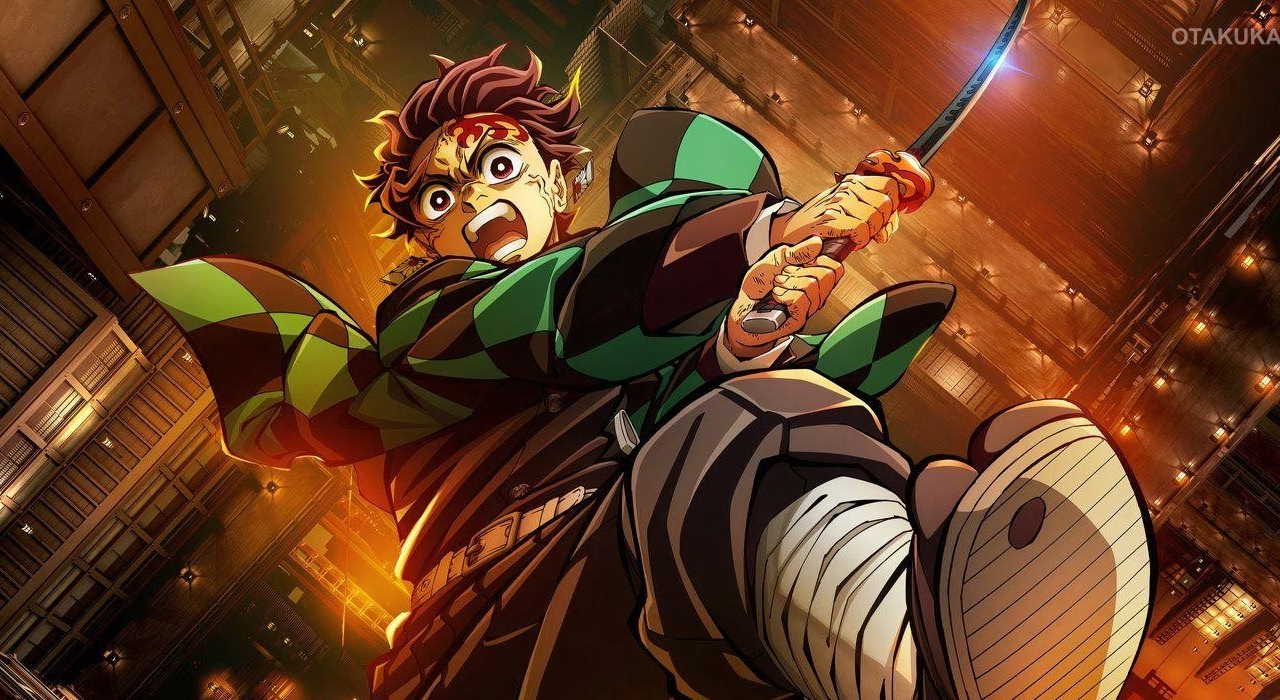
After years of record-breaking television success, Demon Slayer: Infinity Castle Part 1 raises the series to an even more ambitious level through its theatrical presentation. Produced by Ufotable, the film begins the franchise’s highly anticipated final trilogy, bringing the Demon Slayer Corps into a brutal confrontation inside Muzan Kibutsuji’s mysterious Infinity Castle.
The larger cinematic scale allows the story to deliver longer, more detailed battles while giving important character relationships additional emotional depth. Rather than focusing only on flashy sword fights, the film explores sacrifice, determination, grief, and the personal cost of protecting humanity. As the conflict intensifies, every victory carries meaningful consequences, making the emotional stakes significantly higher than in earlier installments.
Visually, the movie showcases Ufotable’s signature blend of detailed character animation, dynamic camera movement, and breathtaking visual effects. The action sequences demonstrate why the studio continues to set new standards for theatrical anime productions, combining technical precision with emotionally driven storytelling.
17. All You Need Is Kill (2025)
Time-loop stories often emphasize action and spectacle, but All You Need Is Kill approaches the concept from a far more psychological perspective. Produced by Studio 4°C and based on Hiroshi Sakurazaka’s novel, the film follows elite soldier Rita Vrataski as she becomes trapped in an endless cycle of death during humanity’s desperate war against an alien invasion. Each failed battle forces her to relive the same events while carrying the emotional burden of every previous attempt.
Instead of treating repeated deaths as exciting action sequences, the story examines the mental exhaustion, loneliness, and emotional trauma created by endless repetition. Rita gradually evolves into a stronger warrior, but every victory comes at a tremendous psychological cost. This realistic portrayal of resilience gives the narrative far greater emotional depth than a typical science fiction adventure.
The animation balances intense battlefield action with quieter character moments, allowing viewers to understand Rita’s emotional state as she struggles to preserve hope despite impossible circumstances. Themes of sacrifice, perseverance, and the value of human connection remain central throughout the film.
Following its release, All You Need Is Kill sparked widespread comparisons with the Hollywood adaptation of Edge of Tomorrow. Many viewers praised the anime version for placing greater emphasis on psychological storytelling rather than blockbuster spectacle. The film has since earned recognition as one of the strongest modern science fiction anime, demonstrating how familiar concepts can feel entirely fresh through thoughtful writing and emotionally grounded character development.
18. Scarlet (2025)
Revenge has inspired countless stories, but Scarlet explores the theme through an emotionally complex and visually imaginative fantasy world. Directed by Mamoru Hosoda, the film follows a young princess whose peaceful life is destroyed after her father’s murder. Determined to seek justice, she begins a dangerous journey that unexpectedly leads her into a mysterious afterlife where people from different eras and civilizations exist together.
As the story unfolds, Scarlet confronts not only powerful enemies but also her own anger, grief, and desire for vengeance. Rather than celebrating revenge, the narrative questions whether hatred can ever truly heal emotional wounds. This moral conflict gives the protagonist significant emotional depth and transforms the film into more than a traditional fantasy adventure.
Hosoda combines a breathtaking fantasy world with emotionally intimate storytelling, creating a visually ambitious world filled with symbolic imagery and imaginative environments. The animation emphasizes both large-scale action and quiet reflective moments, allowing the emotional journey to remain the film’s central focus.
Following its release, Scarlet generated extensive discussion among anime fans and film critics. While many praised its artistic ambition and philosophical themes, others debated whether its message reached the emotional heights of Hosoda’s earlier films such as Belle and Mirai. Those differing opinions have kept the film at the center of ongoing conversations, highlighting its willingness to take creative risks.