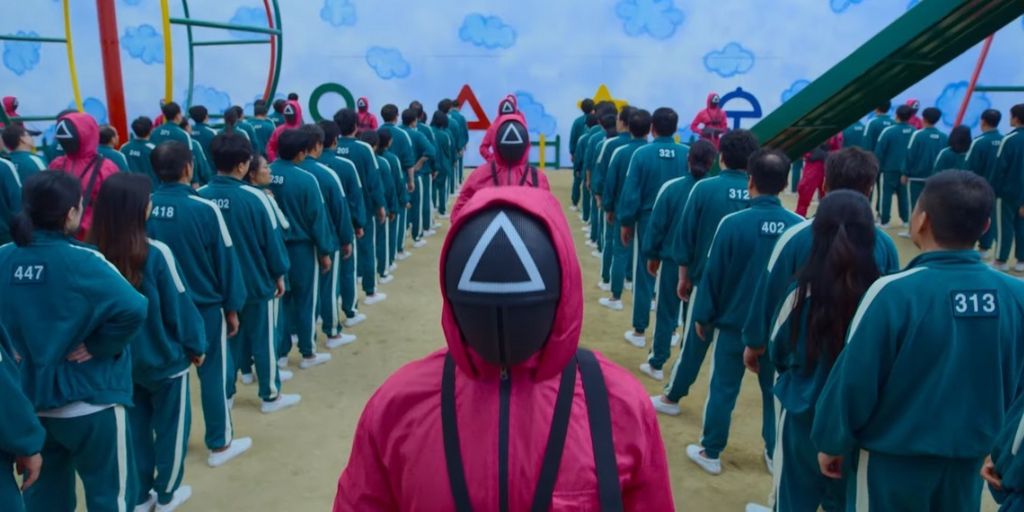
Season 3 builds to a last match that turns Squid Game’s cruelty into something even more disturbing than previous marbles or bridge trials. Instead of adults battling it out, the final contestants are Gi‑hun, Myung‑gi and Jun‑hee’s newborn child, now officially registered as Player 222.
The VIPs and the Front Man decide the baby can inherit her mother’s slot, treating a literal infant as just another betting piece in their entertainment.
Before the last round, Myung‑gi betrays Gi‑hun to secure the prize for himself and his child, trying to kill him even after they had briefly cooperated. His plan backfires during the setup on the concrete pillar structure, and he is eliminated, leaving only Gi‑hun and the baby in an unfinished game that still demands one survivor.
The rules present Gi‑hun with three options: press the button to kill the baby and win, do nothing and let them both die, or push the button in a way that sacrifices himself and allows the baby to live.
Gi‑hun chooses the third path. He places the baby safely on the pillar, steps back toward the ledge, and addresses the unseen VIPs, refusing to behave like an animal in their racetrack.
His last words affirm that the contestants are humans, not disposable commodities, before he falls backward to his death and triggers the result that crowns Player 222 as the winner.
It is a direct reversal of earlier seasons, where desperation often pushed characters to kill for money, and it reframes Gi‑hun as someone who would rather die than let greed claim one more life, especially a child’s.
Also read: Taemin and Noze: The Truth Behind the 2026 K-Pop Dating Scandal
For the VIPs, the baby’s victory is a shocking but still entertaining twist, yet for the story, it represents the purest possible rejection of the system’s logic. Gi‑hun proves that a player can refuse the rigged terms of the bargain, even if it costs everything.
At the same time, the season underlines how rare this choice is, since other finalists were willing to talk about killing an infant as if it were just another strategic step toward a larger payout.
System Burned Or System Escaping? The Island Explodes While The Front Man Lives
Right after the final sacrifice, the series cuts to chaos among the staff as the Coast Guard closes in on the island. The Front Man orders a full evacuation and triggers a self‑destruct protocol, turning the entire facility into a crime scene that will be almost impossible to investigate properly.
Bombs detonate through the complex, and Gi‑hun’s lifeless eyes reflect the flames that consume the arena, a chilling reminder that even his death is surrounded by controlled spectacle.

Hwang Jun‑ho, the returning police officer, finally reaches the island by following Player 246’s boat and swims ashore just as the countdown accelerates. He confronts the Front Man near the pillar where the baby is retrieved, demanding answers about why the games exist and why his own brother chose this path.
The Front Man refuses to confess or repent, turning away and escaping with the other staff while Jun‑ho barely survives the subsequent explosions.
Parallel to this, guard Kang No‑eul, who had secretly helped Player 246, discovers in her personnel file that her daughter is actually dead, a truth the organizers hid to keep her obedient.
Devastated and watching the final game on the monitors, she nearly ends her life but ultimately uses her supervisor’s mask to escape the island as it falls apart.
Her storyline shows how the games weaponize grief, exploiting people’s trauma to lock them into service, and also signals that potential whistleblowers are now scattered in the outside world.
When the Coast Guard picks up Jun‑ho in the water, it feels like the first real chance for legal accountability since season 1’s failed investigation. Yet the show keeps that hope fragile, because almost all physical evidence has been destroyed, and the leadership has escaped with money, contacts, and a global network of rich clients.
That tension between explosive catharsis and frustrating realism is why several critics from outlets like Time, Forbe,s and Netflix’s own TUDUM highlight the finale as both emotionally satisfying and politically bitter, suggesting that justice against entrenched power rarely comes cleanly.
Global Expansion Or Final Warning? What The Los Angeles Tag Teases Next
The last minutes move far from the island, jumping to Los Angeles and making it clear that the games were never just a Korean nightmare. An American recruiter is shown playing Ddakji with a new target, mirroring the very first episodes of the franchise and signaling that the model has quietly spread worldwide.
The Front Man is seen watching this process in the U.S., which implies that he not only survived but also oversees an international branch, treating the destruction of one island as a minor setback in a much larger operation.
Gi‑hun’s sacrifice does secure a future for Jun‑hee’s baby and sends his winnings to his daughter, but it does not magically dismantle the wider system.
Instead, the ending suggests two parallel legacies: one intimate and humane, centered on the lives saved or changed by his choice, and one structural, in which wealthy patrons adapt and rebuild the games wherever regulation is weaker and desperation is easy to exploit.
This duality has fueled online debates, with fan threads and think pieces arguing whether the finale is a call to action for viewers or a bleak statement that individuals can only do so much against globalized exploitation.
What stands out is how Season 3 circles back to the show’s earliest themes about debt, predatory capitalism, and moral compromise. Contestants repeatedly voted to keep playing this time, even when the prize money could be split among survivors, because each person believed just a little more risk would solve everything.
By the time men calmly debate killing a newborn for a larger jackpot, the series has stripped away any illusion that the games are merely forced cruelty instead of an exaggerated mirror of choices people already make in less extreme economic systems.
That final Ddakji scene in Los Angeles works as a quiet gut punch. The series hints that someone, somewhere, will have to “step up” after Gi‑hun, echoing fan discussions on Reddit that frame the ending as an open question to viewers about who fights the system next and how they do it without becoming what they oppose.
Season 3 closes not with a neat victory, but with a baby who inherits bloodstained money, a survivor who might speak to authorities, and a machine that continues to recruit its next desperate players, country by country.
Also read: James Cameron Net Worth: Earnings from Avatar: Fire and Ash $1B Success