
Pearl Abyss is taking an unusual approach to environmental storytelling in Crimson Desert, designing important landmarks to attract players from approximately one kilometer away while revealing their finer details when approached within 10 meters. Rather than relying entirely on quest markers, dialogue, or scripted events, the studio wants players to discover the continent of Pywel through visual clues scattered across its open world.
The design philosophy was explained by Ahn Keun-tae, Lead of Pearl Abyss’ Art Level Division, during a G-CON presentation at G-STAR on November 19, 2026. As reported by Inven, the developer discussed how environmental design can encourage exploration by giving players something interesting to notice and investigate.
According to Ahn, distant landmarks should function like an opening sentence in a story. They need to capture attention without revealing everything immediately. Once players arrive, details such as collapsed structures, visible damage, and traces of past events provide a deeper understanding of the location.
Why Crimson Desert Designs Landmarks From Two Distances
The developers found that making a landmark noticeable is only half the challenge. If a structure stands out too much, it can feel disconnected from its surroundings. However, if it blends completely into the landscape, players might never notice it.
Pearl Abyss therefore evaluated important locations from multiple perspectives, including different approach angles and weather conditions. The skyline received particular attention because players often recognize a structure’s silhouette against the sky before noticing its architectural details.
Ahn also explained that the team repeatedly tested distant locations by identifying a landmark from a ridge and physically walking toward it. The goal was to establish trust that anything visible on the horizon could actually be reached.
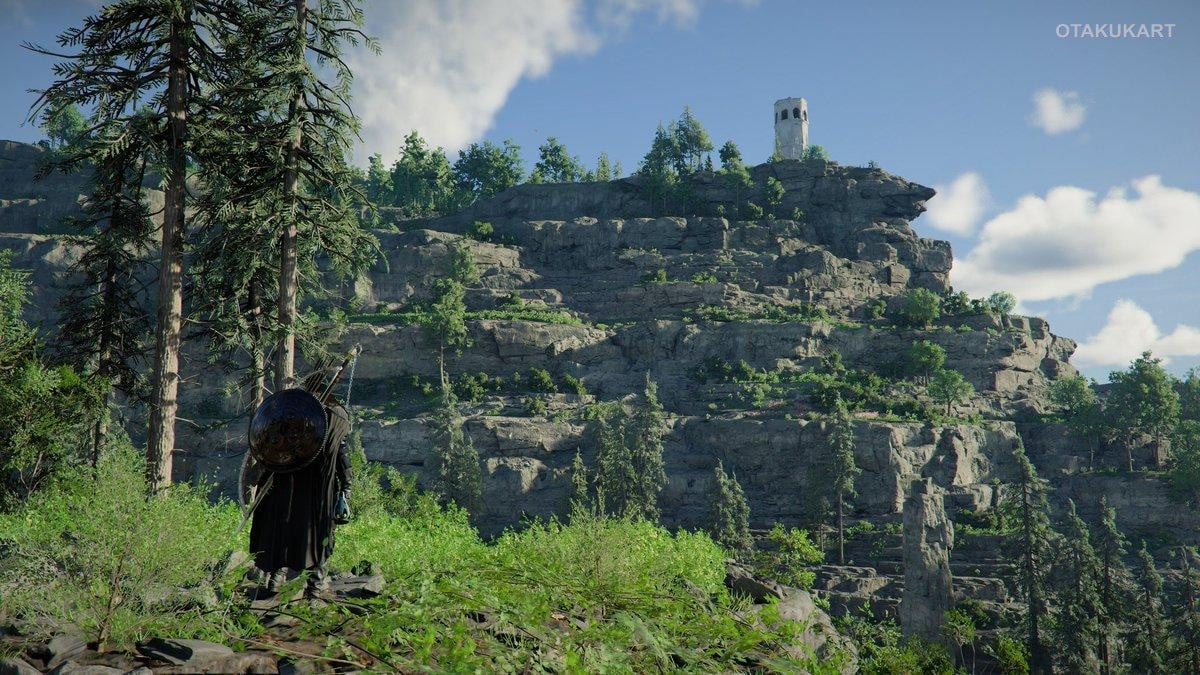
As Ahn explained during the presentation, discovery creates a question, movement becomes the deduction, and reaching the destination provides the answer. That discovery can then encourage players to investigate another location.
The landmark philosophy is supported by Pearl Abyss’ proprietary BlackSpace Engine, which powers the approximately 200-square-kilometer continent of Pywel.
During the same presentation, Graphics Division Lead Yoon Jin-ho discussed the technology behind the seamless environment, including procedural vegetation, dynamic lighting, weather simulation, and level streaming. The engine also uses multiple levels of detail to maintain visual consistency between nearby objects and distant landscapes.
These systems support the studio’s central objective: making the environment an active part of exploration rather than simply a backdrop for gameplay.

| Platforms | PC, PlayStation 5, Xbox Series X/S |
|---|---|
| Developer | Pearl Abyss |