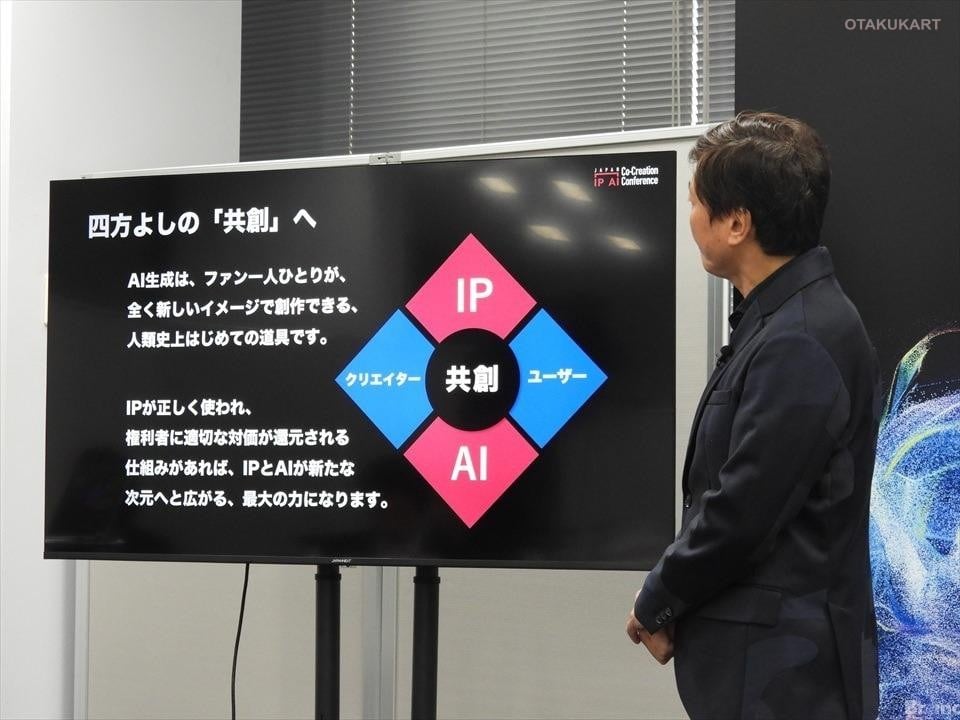
Japan is taking steps to protect its entertainment industry as generative AI raises concerns about the unauthorized use of copyrighted material. A newly established organization, the Japan IP.AI Co-Creation Association, wants to create a system that allows anime, manga, music, and other intellectual property owners to set clear conditions for AI companies using their work.
The initiative was introduced at a press conference in Tokyo on September 11, 2026. Its proposed framework would let rights holders decide in advance whether their creations can be used for AI training, commercial projects, or social media content. Participating AI companies would then record usage and distribute payments to the respective rights holders.
The association hopes the framework will make it easier for AI developers to legally access Japanese creative works without depriving their original creators of control or compensation.
Japan Wants to Establish a Global Licensing Standard for Anime and Manga AI Use
The proposed framework is built around the idea of moving from unauthorized use towards a licensing-based relationship between intellectual property owners and AI developers. Participating rights holders would be able to specify whether their creations can be used for commercial generation, AI training, or social media content. They could also restrict particular materials and forms of expression.
The association is promoting these rules through the Global IP.AI Co-Creation Declaration, which outlines six principles, including respect for intellectual property, appropriate licensing, transparency, and cooperation between creators and technology companies. Its technical infrastructure, called Kagami Gate, is intended to help verify permissions, monitor usage, and distribute payments.
Nine overseas AI companies have reportedly endorsed the guidelines, including Alibaba, Canva, MiniMax, PixVerse, and HeyGen. Rights holders associated with Captain Tsubasa and lyricist-producer Yasushi Akimoto have also supported the initiative.
Captain Tsubasa and AKB48 Could Become Part of the Initiative
The framework is already attracting interest from Japanese entertainment properties. The rights holders of Captain Tsubasa have authorized the series for AI training, while discussions are underway to include works associated with AKB48, the idol group produced by Akimoto.
MiniMax has also indicated that it would adopt the system, while ByteDance’s Japanese subsidiary has been in discussions about potential participation. The association intends to approach additional major technology companies, including Google and OpenAI.
Takami Kondo, the association’s representative director, described the initiative’s ambition at its launch:
“With the advent of generative AI, the mechanisms surrounding IP are on the verge of profound change,”
he said.
“We want to create a new global standard, and to do so from Japan.”
The initiative could become significant for Japan’s anime, manga, and gaming industries, whose intellectual properties have growing international audiences. However, its long-term impact will depend on how many major rights holders and AI developers adopt the framework and how effectively it ensures that creators receive compensation.