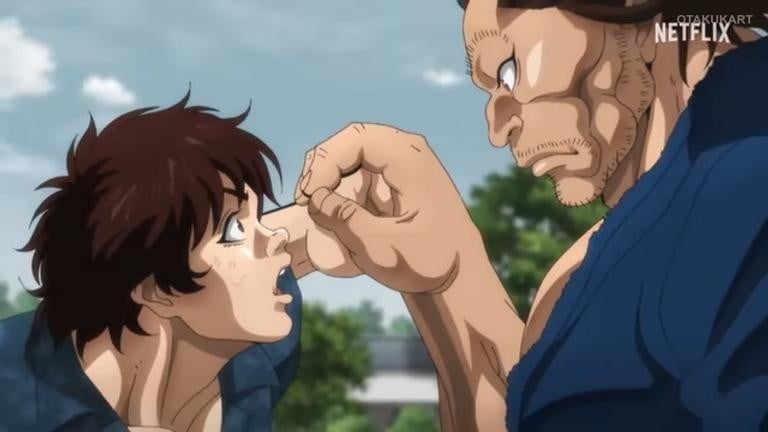
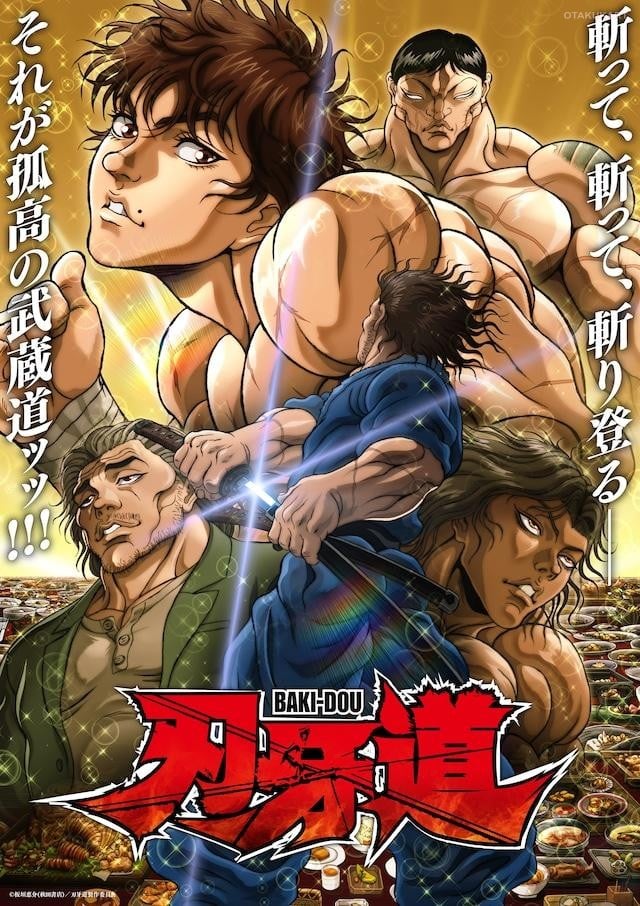
Baki-Dou: The Invincible Samurai producer Kei Watabiki has explained why preserving the distinctive identity of Keisuke Itagaki’s manga was a higher priority than simply making the anime’s fights look more visually spectacular. As the latest installment brought Baki Hanma and his fellow fighters into conflict with the resurrected Miyamoto Musashi, the production team faced the challenge of adapting a story built around both hand-to-hand combat and deadly swordsmanship.
In an exclusive interview with Animehunch, Watabiki discussed the production philosophy behind Baki-Dou, the difficulties of adapting Musashi’s Niten Ichi-ryu fighting style, and the importance of maintaining what the team considers the series’ essential “Baki-ness.”
Baki-Dou’s producers wanted to protect the manga’s identity
According to Watabiki, the production team did not view flashy animation as the ultimate measure of success. Instead, one of his primary responsibilities was ensuring that everyone involved had a consistent understanding of what makes Baki feel like Baki.
“There are of course constraints on time and budget, but I will never make a choice that sacrifices that ‘Baki-ness’ for the sake of efficiency,”
Watabiki told Animehunch. He also explained that adding more visual flourishes does not automatically improve an adaptation.
The producer said the team eventually learned that
“lavish techniques don’t necessarily lead to good results.”
Rather than constantly adding new elements, the staff focused on keeping the production aligned with the identity of Itagaki’s original work.
That approach is particularly important for Baki-Dou, which introduces a major change to the franchise’s established combat formula.
Musashi Miyamoto changed the way Baki’s fights work
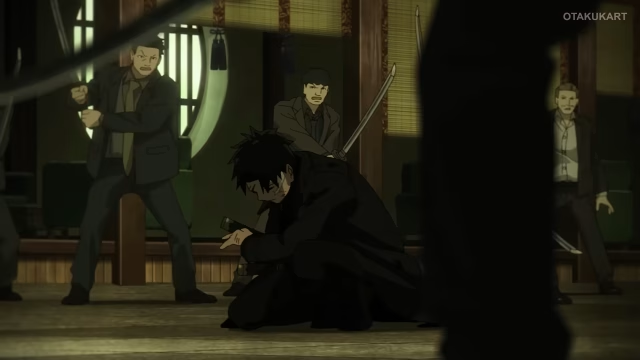
The appearance of Miyamoto Musashi presented a different challenge from the series’ traditional battles. Baki has historically placed considerable emphasis on punches, kicks, grappling and other forms of unarmed combat. Musashi, however, brings swords and the Niten Ichi-ryu style into that world.
Watabiki said the team avoided independently reinventing Musashi’s fighting style for the anime. Instead, the production staff used Itagaki’s manga as its fundamental reference point and focused on translating the author’s portrayal of Musashi to animation.
The challenge was not simply showing a character swinging a sword. The team had to communicate the danger of fighting someone whose weapon could reach an opponent before that opponent could respond.
Watabiki specifically highlighted the difficulty of conveying the sense of danger created by Musashi’s blade and his fighting spirit across the entire frame. This meant that the direction had to carefully consider movement, stillness and the exact moments that deserved the greatest visual impact.
Director Toshiki Hirano was also praised for his ability to translate Itagaki’s dense artwork into animation without unnecessarily over-polishing it. Watabiki said Hirano understood when an action should move, when it should remain still and which moment needed to carry the most weight.
The Netflix era has expanded Baki’s global audience
Watabiki also reflected on how the partnership with Netflix has helped Baki reach audiences outside Japan. The producer identified simultaneous worldwide releases as one of the partnership’s biggest advantages, allowing the series to reach international viewers at the same time.
The production team has noticed that overseas viewers are often among the first to respond when promotional videos are released. Watabiki said this international reaction has become an important source of encouragement for the staff.
The broader production team has similarly acknowledged the franchise’s expanding global reach. In another interview with Final Weapon, Watabiki noted that Baki-Dou has helped introduce the franchise to younger and international audiences, while director Hirano described the series as a potential gateway for viewers who want to explore earlier Baki installments.
Baki-Dou’s producer says the franchise still has more to offer
Despite reaching the end of the Musashi Miyamoto storyline, Watabiki does not believe Baki has exhausted its potential. When discussing the future of the franchise, he said there is still “so much appeal left to deliver.”
For now, the producer remains focused on maintaining the qualities that have defined Itagaki’s work for decades. Rather than chasing spectacle for its own sake, the Baki-Dou team appears determined to make sure the series retains the unusual intensity, unpredictability and combat philosophy that fans associate with Baki.
With Baki-Dou continuing to expand the franchise’s audience through Netflix, that balance between modern animation and Itagaki’s original identity could become increasingly important for the series’ future.