When The Sixth Sense premiered in 1999, no one could have predicted just how deeply it would influence both audiences and filmmakers. Directed by M. Night Shyamalan, the film told the haunting story of a young boy, played by Haley Joel Osment, who claims he can see and talk to the dead.
Bruce Willis starred as his troubled child psychologist, while Toni Collette played the boy’s emotionally drained mother a performance that earned her an Academy Award nomination for Best Supporting Actress.
The movie became a monumental success, grossing over $670 million worldwide and earning six Oscar nominations, including Best Picture. Yet, what continues to make The Sixth Sense extraordinary is how it transcends genre boundaries.
While widely remembered for its unforgettable twist ending and eerie atmosphere, the film is also deeply moving, portraying love, grief, and parental guilt with remarkable realism.
Toni Collette’s performance, steeped in authenticity and empathy, grounded the movie in human emotion. Her tearful scenes with Osment remain some of the most talked-about moments in late-1990s cinema.
Also read: Tomo Sakurai: Beloved Voice of Pokémon’s Cynthia Passes Away at 53
However, in a recent revelation during an interview on Q with Tom Power, Collette admitted she didn’t initially realize the movie she was making was a horror film at all.
Toni Collette’s Honest Revelation
During the podcast, Collette laughed as she recalled the moment she found out she was part of a film far more terrifying than she had expected. She shared that early in production, she viewed some of the editing footage on set and discovered the shocking truth about the movie’s tone.
“I remember walking past a makeshift editing suite,” she said, describing her surprise as she watched the scene where Haley Joel Osment’s character encounters the ghost of a young girl, played by Mischa Barton. “He walks past the bed, and she reaches out and grabs him. And I thought, ‘Oh my God, this is a horror movie!’”
Her genuine surprise reveals how subtle and understated M. Night Shyamalan’s directing style was during filming. As Collette explained, she had originally seen The Sixth Sense as a moving and spiritual story a meditation on loss and human connection.
Only later did she fully understand just how effectively Shyamalan had fused psychological drama with supernatural horror.
For many actors, reading a script gives a clear idea of a film’s tone. But in this case, Collette’s misreading demonstrates how seamless Shyamalan’s approach was.
The film’s emotional core was so strong that even one of its stars didn’t initially recognize the underlying horror elements. That balance is precisely what made The Sixth Sense a genre-defining masterpiece.
How The Sixth Sense Mastered Genre Fusion
Shyamalan’s ability to merge visual tension with heartbreak is key to why The Sixth Sense remains so powerful after more than two decades. While many horror films lean heavily on jump scares or gore, this movie built its tension through quiet dread and emotional vulnerability.
The fear emerges not just from seeing ghosts but from understanding why they linger, anchored by a story about unhealed wounds and unfinished business.
Toni Collette’s characterization of Lynn Sear, the struggling single mother, represents the soul of this film. Her grounding performance provides the audience with a sense of emotional stability amid the supernatural chaos.
Her character’s exhaustion, frustration, and fierce love for her son make her relatable, even as the story spirals into the uncanny.
This careful balance between emotional reality and supernatural mystery may be why Collette initially missed the movie’s genre. Much of her screen time centers on emotional conversations with her son rather than moments of terror.
For her character, the film’s horrors exist more through confusion and helplessness than direct confrontation with ghosts. That distinction allowed Collette to play Lynn as a mother driven by empathy, not fear.
Her misunderstanding actually underscores how The Sixth Sense blurred traditional genre lines. It wasn’t simply a “horror movie,” but an intimate study of grief hiding inside a ghost story. The movie’s success came from that exact equilibrium between striking fear and evoking compassion.
A Testament to M. Night Shyamalan’s Storytelling
Collette’s candid memory shines a new light on Shyamalan’s skillful storytelling. The filmmaker’s power has always rested on his ability to disguise genres inside relatable human stories.

By filming many scenes in a subdued, emotional tone, he encouraged his actors to focus on psychological truth rather than stylized fright. That approach helped nurture honest performances that made the film’s shocks more believable.
For Shyamalan, The Sixth Sense was not just another ghost tale it was a story about communication, connection, and redemption. Even the now-famous line “I see dead people” became emblematic not merely of horror but of emotional distance between those who need help and those unwilling to listen.
That subtlety also explains why Colette and her fellow cast members did not initially sense the true genre they were building. Instead of treating ghosts as monsters, the script portrayed them as lost souls.
The horror came from the emotional tragedy underlying their appearances a concept that set Shyamalan apart from other directors of his era.
Collette’s reflection reaffirms that method’s impact. The film didn’t require gruesome imagery or over-the-top performances; its power came from atmosphere, pacing, and an emotional resonance that hit audiences deeply. It is this unique blend that turned Shyamalan’s movie into a permanent part of cultural conversation.
The Legacy of The Sixth Sense and Toni Collette’s Role
Two and a half decades later, The Sixth Sense continues to influence filmmakers, critics, and fans alike. Its twist ending remains one of the most discussed moments in film history, but its longevity owes much to the humanity embedded in every performance.
Toni Collette’s portrayal helped ground the supernatural narrative, showing how fear and love coexist when protecting someone you care about.
Her later career proved that this emotionally intelligent approach would define much of her work. From Hereditary to Muriel’s Wedding, Collette has made a career out of bringing realism and vulnerability to emotionally complex characters.
Yet her comments on The Sixth Sense prove that even an experienced actor can be swept up in the emotional core of a story so completely that they miss its darker undertones.
Shyamalan’s masterpiece paved the way for a new kind of horror, one driven by empathy rather than brutality. The revelation that Collette didn’t realize the genre during shooting only reinforces the subtle brilliance of the film’s execution.
Watching it today, one understands why her performance and Shyamalan’s direction created an experience that moved audiences to both tears and chills.
Toni Collette’s laughter at her own surprise underscores how transformative acting can be. Sometimes, understanding a film’s heart means seeing its ghosts only after the fact.
Also read: Peacemaker Season 2 Episode 1 Review: A Gritty Return to Chaos
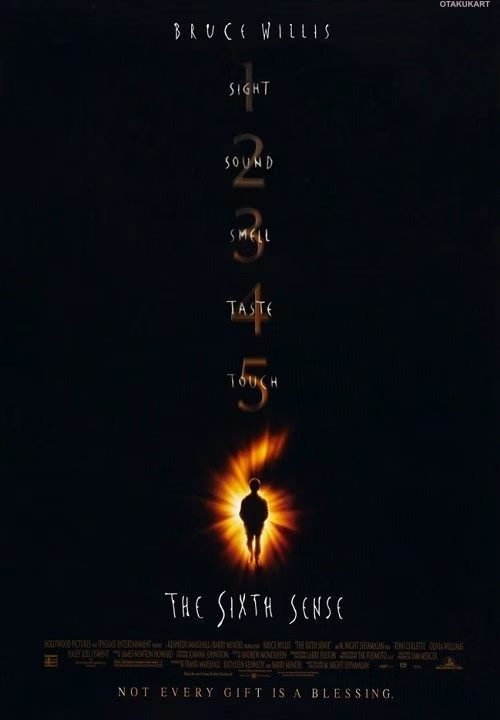
| Release Date | August 6, 1999 |
|---|---|
| Studio | Hollywood Pictures, Spyglass Entertainment |
| Director | M. Night Shyamalan |
| Writer(s) | M. Night Shyamalan |