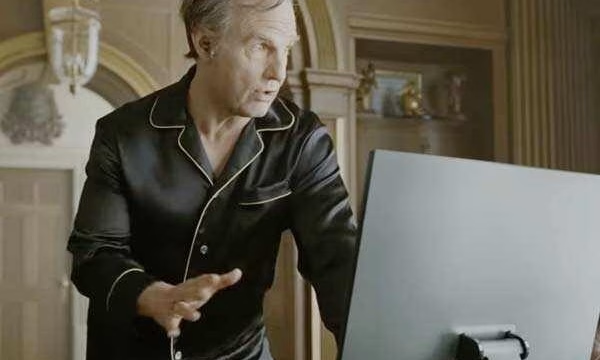
Good News (2025), directed by Byun Sung-hyun, marks a bold entry in Korean genre cinema, an over-the-top, satirical amalgamation of disaster movie, political thriller, and biting social commentary.
Loosely inspired by the real 1970 hijacking of a Japanese plane by members of the Red Army Faction, the film ventures into the murky waters of misinformation, government manipulation, and national paranoia.
Set amid the Cold War tensions of the 1970s, the story revolves around the chaos that erupts when a Japanese commercial passenger flight is taken over by a group of militant extremists.
Their goal? To make an ideological statement, which spirals into a farcical international mess involving South Korea, North Korea, the United States, and Japan. The hijackers demand to be flown to Pyongyang, but the layers of bureaucratic incompetence, covert agendas, and media spin make the situation escalate into absurdity.
The film’s tone mimics that of classic satirical hits like Dr. Strangelove and The Good, The Bad & The Ugly, blending dark humor with scenes of political absurdity.
Also read: Airbnb’s 15.5% Host Fee Shift Sparks Pricing Rethink Among Property Managers
Sung-hyun’s command over tone is evident, as the story shifts seamlessly between tense standoffs and slapstick moments, all underscored by a sharp critique of how governments distort reality to maintain control.
The Man Behind the Curtain: Nobody as the Mastermind
Central to the narrative is a mysterious figure known simply as “Nobody,” played by Sul Kyung-gu. His elusive presence and inscrutable demeanor evoke the archetype of the behind-the-scenes fixer, someone who manipulates events without revealing their true motives.
This character, who claims to be “a nobody,” is a master strategist working in the shadows, and his influence extends across the scene.
Nobody’s role in the hijacking crisis epitomizes the film’s perspective on power. He operates outside institutional boundaries, stitching together a web of lies and half-truths, while various government agencies, South Korea’s KCIA, Japanese Defense, and American intelligence, squabble over control.
His ingenuity lies in weaving a narrative that keeps everyone guessing, highlighting how media and politics often serve the same purpose of distraction.
Sul Kyung-gu’s portrayal of Nobody combines charisma with smoldering menace, fitting perfectly into the film’s critique of opaque leadership and the delusion of authority.
His calm, strategic manner stands in stark contrast to the chaos on-screen, a symbol of the manipulative forces that often go unseen but have their hands on the levers of power.
The Hijacking: A Game of Masks and Misinformation
As the hijackers, armed and stubborn, demand a flight to North Korea, the film unravels into a whirlwind of strategy, deception, and misdirection.
The hijacking itself becomes a battleground where diplomatic efforts clash with outright farce, one side trying to save lives, the other gridlocked by bureaucratic indecisiveness and national greed.
The characters involved, especially Seo (Hong Kyung), an overly ambitious air traffic controller, symbolize the chaos of a system that is both too large to manage and too divided to function properly.
Seo’s internal conflict, his desire for fame and patriotism versus the dirty realities of sabotage and misinformation, embodies the film’s critique of posturing and political spin.
The film also satirizes American self-image and global diplomacy. Scenes of government officials panicking and aircraft lining up in utterly useless double-parking tactics evoke a sense of world leaders operating on superficial gestures rather than genuine action.
From fake Pyongyang airport recreations to confusing communications, Good News crafts a universe where truth is nothing more than a scripted performance.
Misinformation as a Weapon: Truth and Lies in the Media
At its core, Good News is an investigation into how stories are shaped and manipulated. Throughout the film, characters with fluctuating loyalties and unreliable narratives highlight the blurred lines between fact and fiction.
The film questions whether any story told in the heat of crisis can be believed as truth, or if all reports are just constructs used to serve someone’s interests.

Sung-hyun’s direction depicts the media, politicians, and military officials as players in a game where no one is trustworthy. A scene in which a fake government broadcast is spun as real news emphasizes the film’s warning that public perception can be manufactured, and “truth” can be as fragile as a house of cards.
The climax culminates in a tense negotiation, orchestrated by Nobody, where the line between reality and fake news becomes indistinguishable. As the hijackers threaten to detonate a bomb, the story dissects how fear, propaganda, and misinformation can override rational decision-making, turning a crisis into chaos.
The Paradox of Power and Humanity
While soaked in satire and dark humor, Good News also reflects on human fragility beneath the masks of authority. The characters’ inability to act decisively or distinguish what is real exposes the danger of complacency in times of crisis.
The film portrays a society so conditioned to trust authority that when chaos erupts, few understand what the real stakes are.
The film’s crowning achievement is its capacity to make viewers laugh while simultaneously terrifying them with the realization that such absurdity could happen in real life. It asks if governments and media can ever be truly honest, or if their primary goal is to maintain the illusion of control.
As the credits roll, the lingering question remains: in an age where truth and fiction are often interchangeable, can societies ever truly find clarity? Or are they destined to be manipulated by unseen puppeteers guiding the narrative for their own ends?
Good News stands as a provocative piece of cinema that refuses to offer easy answers. Its combination of mordant humor, political critique, and intense suspense makes it one of the most thought-provoking Korean films of the year.
It reminds audiences that sometimes, the most dangerous stories are the ones we are told to believe.
Also read: When Big Studios Pull the Plug: Behind Gaming’s Most Costly Cancellations