

Claim
A viral picture authentically shows the night sky on Mars as a dazzling, hyper-detailed Milky Way above a rover deck, demonstrating “what Mars really looks like at night.”
Rating
Misleading
About this rating: The foreground appears Mars-like, but the sky is a composited/repurposed star field, not a rover photograph. NASA’s authentic rover imagery of Mars at night—including the well-known frame where Earth appears as a tiny dot—shows a much dimmer, dust-muted sky. The viral image is therefore misrepresented as documentary photography.
Context
In late 2025, posts across X, Instagram Reels, YouTube Shorts, and Facebook claimed to reveal an astonishing view of the Martian night sky: a rover or rover-like platform in the foreground beneath a glittering, color-rich band of the Milky Way. Captions typically asserted that this is how Mars looks after dark, sometimes implying the picture came from NASA’s Curiosity or Perseverance rover, or from a “new telescope on Mars.”

NASA has, in fact, published real night-sky imagery from Mars. The most iconic example is Curiosity’s 2014 frame taken from Gale Crater, where Earth appears as a faint star-like point above the horizon. NASA’s official resource page for that image is here:
https://science.nasa.gov/resource/earth-from-mars/
https://mars.nasa.gov/mars2020/multimedia/raw-images/

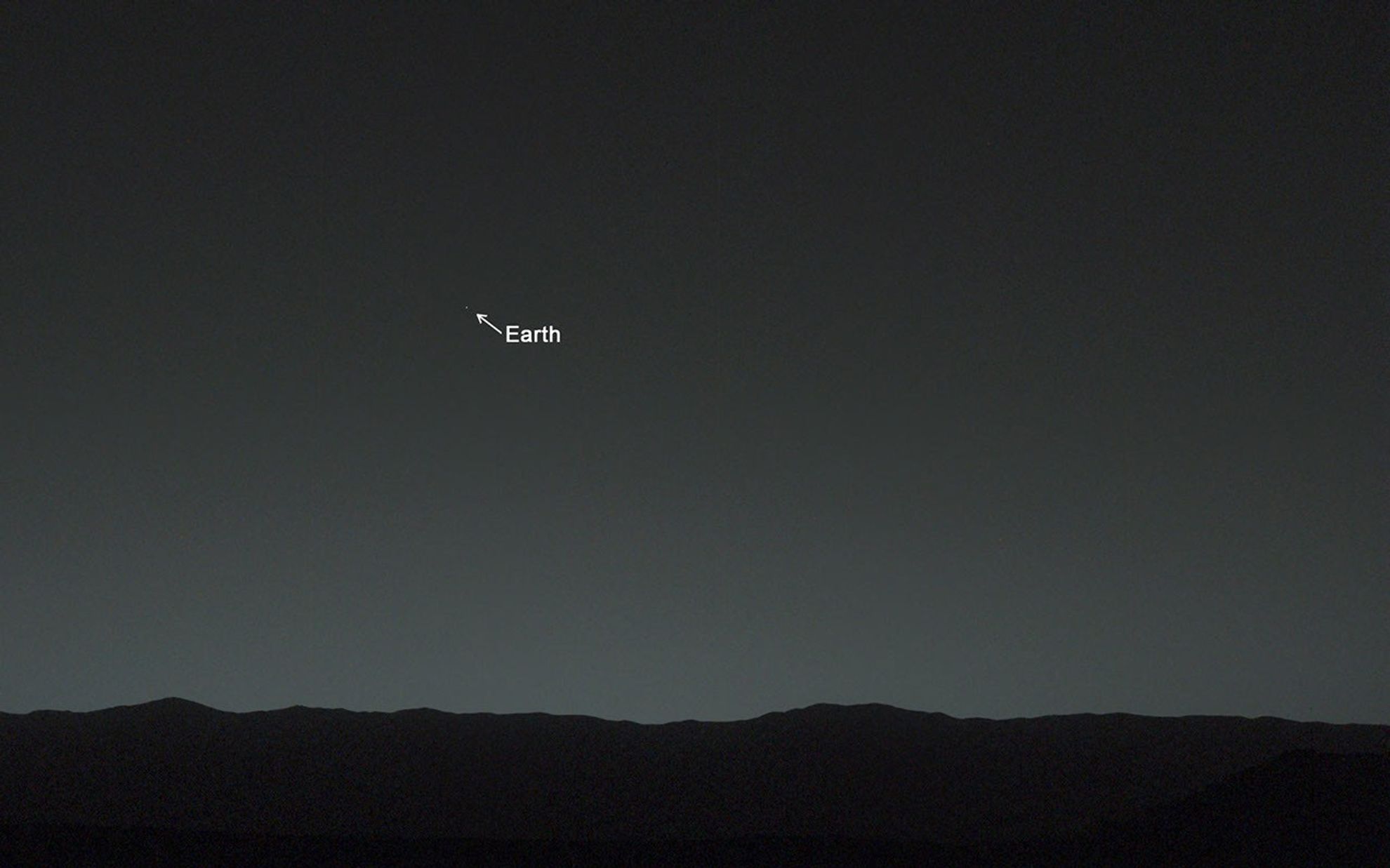
That authentic photo, and others like it, establish the baseline for how Mars’ sky is recorded by rovers: subdued, dusty, and comparatively low-contrast—nothing like the viral composite.
You can check over 146,000 photos by NASA:
https://mars.nasa.gov/mars2020/multimedia/raw-images/

What the authentic record shows
-
Dim, dust-affected skies: Mars’ atmosphere is thin but dusty. Fine particles scatter sunlight, especially at dusk and dawn when rovers often point cameras skyward. This reduces contrast and mutes the Milky Way’s glow.
-
Rover cameras are geology-first: Systems such as Mastcam (Curiosity) and Mastcam-Z (Perseverance) are engineered to document rocks, layers, and hardware—not to operate as tracked deep-sky observatories.
-
No sky tracking: Rovers do not use equatorial mounts that compensate for planetary rotation. Long exposures would trail stars, so sky frames are short, limiting faint detail.
-
Provenance and metadata: Authentic rover photos are accompanied by a sol (Martian day) number, instrument name, and mission context, and they appear in NASA/JPL archives. The viral image lacks these identifiers and does not appear in official repositories.
In short, when NASA releases a night view from Mars, it looks modest and scientifically calibrated. The famous 2014 frame shows Earth as a small, bright dot against a dark horizon—powerful precisely because it is understated.
Why the viral picture is miscaptioned/misleading
1) Improbable Milky Way brightness and structure.
The sky in the viral composition displays the kind of razor-sharp, high-contrast star field that, on Earth, requires tracked, multi-minute stacked exposures or a mosaic from professional observatories. A stationary rover mast camera cannot produce that look in a single frame.
2) Foreground/sky mismatch.
The noise pattern, color curve, and dynamic range of the lower (terrain/rover) portion do not match the star field. This is a common giveaway that two unrelated images were combined.
3) Optical/pixel-scale tells.
Across a very wide field, the stars remain ultra-pinpoint and evenly resolved—behavior typical of large, fast optics designed for astrophotography. Rover cameras have different pixel scales and aberration profiles.
4) Shifting attributions.
As the image spreads, captions alternately credit Curiosity, Perseverance, and a speculative “Mars telescope.” Conflicting origin stories are a hallmark of repurposed or fabricated visuals.
Could Mars’ Milky Way ever look like that to a camera?
In principle, a human observer on a very clear, dust-low night on Mars could perceive the Milky Way band, just as on Earth at dark sites. But to record the Milky Way with the clarity and depth shown in the viral picture, you would need tools the rovers don’t carry: a tracking mount, long/stacked exposures, a large, fast aperture, and extensive post-processing. Mars missions prioritize science and safety, not gallery astrophotography; night imaging windows are short and tightly constrained.
How people get misled online
-
A kernel of truth: NASA really did show Earth in Mars’ night sky—as a tiny dot—so viewers find dramatic “Mars night” claims plausible.
-
Algorithmic aesthetics: Platforms reward eye-popping visuals. Subtle, accurate science images lose out to spectacle.
-
Context collapse: With reshares, credits and caveats vanish; artwork or composites are retold as “NASA just released this.”
-
Technical opacity: Most users don’t know instrument limits; without that context, nearly any space claim can feel believable.
What the real image looks like (and why it matters)
The authentic benchmark for a Mars night scene remains NASA/JPL’s 2014 Curiosity frame: a dark horizon under a dust-softened sky, with Earth as a star-like point. That quiet reality underscores scale, distance, and the constraints of imaging from another world. Presenting a composited Milky Way as a rover photograph blurs the line between art and documentary, undermining public trust and overshadowing the genuine achievements of planetary exploration.
How we verified
-
Primary source review: NASA’s “Earth from Mars” page (Curiosity, 2014) establishes how the Martian night appears in official rover imagery and provides mission context and instrument information.
-
Archive and capability check: Public NASA/JPL galleries list no rover images matching the viral sky’s star density and coloration. Rover camera documentation and usage confirm they are not tracked deep-sky systems.
Our verdict
False portrayal / Misleading. The viral picture is not a documentary photo of Mars’ night sky. It is a composite or otherwise manipulated image miscaptioned as a rover capture. The authentic appearance of a Martian night sky in NASA releases is restrained; at most, you may see a faint Earth as a small point of light.
Sources
-
NASA: Earth from Mars (Curiosity, 2014) – https://science.nasa.gov/resource/earth-from-mars/
-
NASA/JPL mission galleries and instrument overviews for Curiosity Mastcam and Perseverance Mastcam-Z (general capability context). – https://mars.nasa.gov/mars2020/multimedia/raw-images/