In the early 1930s, while grading examination papers, Professor J.R.R. Tolkien scribbled a line that would become one of the most famous introductions in literature. In the margin of a blank space, he wrote, “In a hole in the ground there lived a hobbit.”
This simple sentence would later evolve into the opening of The Hobbit, published in 1937. It served as a gateway to Tolkien’s vast and richly detailed fantasy world, a universe that would expand in The Lord of the Rings and other works.
Tolkien’s imagination was influenced by several significant factors: his deep Christian faith, the trauma of his experiences in World War I, and his passion for Germanic and English history.
These elements formed the foundation of the modern fantasy genre as we know it today, particularly the magical creatures that fill the pages of his stories.
Among these mythical beings, dragons hold a special place. Dragons are a cornerstone of Tolkien’s world, and their influence extends far beyond his books, becoming an integral part of fantasy literature as a whole.
Dragons in Tolkien’s writings weren’t simply mindless beasts but intelligent, cunning, and sometimes tragic figures that could speak, plot, and scheme. They possessed near-impenetrable scales, hoarded vast treasures, and had a hypnotic power called the “dragon-spell,” capable of enthralling those who made eye contact with them.
Inspired by classic myths, such as the dragon from Beowulf and the legendary Fáfnir, Tolkien’s dragons embodied many of the traditional dragon archetypes, yet he gave them a unique twist.
The Dragons of Middle-earth
The world Tolkien built in The Hobbit, The Silmarillion, and The Lord of the Rings is brimming with magical creatures, but dragons are among the most memorable and important. Created by Morgoth, the first Dark Lord, dragons were an integral part of his armies in the First Age as he sought control of the world.
They came in many forms: some had wings and could breathe fire, while others, like the Cold-drakes, lacked these abilities but still posed a deadly threat.
What united them was their intelligence, cunning, and obsessive need to guard their vast hoards of treasure. This treasure hoarding was more than a simple love for gold—it was almost an intrinsic, magical desire that they fiercely defended.
Dragons also had an inherent weakness: their soft underbellies, which was often their only vulnerable spot. Despite their overwhelming strength and intelligence, this physical flaw could be exploited by brave or lucky warriors. However, dragons were not numerous.
They took centuries to mature, and Morgoth was unable to mass-produce them for his armies. After Morgoth’s defeat at the end of the First Age, dragons became less prominent, and the surviving ones never reached the glory of their predecessors.
Though Tolkien referenced several dragons in his work, such as Gostir, not all of them are well-known or developed. Fortunately, four key dragons—Scatha, Ancalagon, Glaurung, and Smaug—play pivotal roles in shaping the history of Middle-earth.
These dragons serve as symbols of power, destruction, greed, and tragedy. They offer insight into Tolkien’s mythological inspirations and have since become templates for how modern fantasy writers portray dragons.
4. Scatha: The Great Worm of the Withered Heath
One of the dragons that continued to live after Morgoth’s defeat was Scatha, often referred to as Scatha the Worm. Scatha lived north of the Grey Mountains in a region known as the Withered Heath, where other dragons also resided after Morgoth’s downfall.
He is mentioned briefly in The Lord of the Rings: The Return of the King, specifically in the appendices, but despite his limited appearance, Scatha played an essential role in the history of Rohan.
Scatha was a wingless dragon, often believed to be a Cold-drake due to his lack of fiery breath. He battled the dwarves living in the region, stealing much of their treasure to add to his hoard.
However, Scatha’s reign came to an end when he was killed by Fram, the Lord of the Éothéod, a group of people who would eventually become the Rohirrim of Rohan. After slaying Scatha, Fram refused to return any of the stolen treasure to the dwarves, sending them the dragon’s teeth instead as an insult.
This defiance mirrors the actions of Thorin Oakenshield in The Hobbit, where Thorin refuses to share Smaug’s treasure, leading to a conflict over wealth.
It is suggested that Fram may have been killed by the dwarves for this insult, but one piece of Scatha’s treasure, the Horn of the Mark, eventually made its way into the hands of Meriadoc Brandybuck.
The horn, which was a symbol of pride and honor for Rohan, passed from bloody battles to being given freely as a gift of friendship. This transformation illustrates one of Tolkien’s recurring themes: how treasure, often a cause of conflict, can also serve as a bridge between different peoples.
Although Scatha is not as well-developed as other dragons, his existence provides an important link between the early history of Middle-earth and the later events of The Lord of the Rings.
His story also reflects Tolkien’s interest in the cyclical nature of history, where the actions of one generation echo through the ages, influencing the choices and outcomes of those who come later.
3. Ancalagon the Black: The Winged Terror of Morgoth
If Scatha represents the smaller, more localized threats of Tolkien’s world, Ancalagon the Black is the embodiment of ultimate destruction on a grand scale. Ancalagon is the largest and most fearsome dragon in Middle-earth’s history, and he plays a crucial role in The Silmarillion, Tolkien’s epic account of the First Age.
Ancalagon was created by Morgoth during the First Age and was the leader of the winged dragons. He was Morgoth’s secret weapon, unleashed during the War of Wrath, the final battle between Morgoth’s forces and the armies of the Valar.
After Eärendil, the father of Elrond, sailed to Valinor to plead for help in defeating Morgoth, the Valar sent their forces to Middle-earth.
Morgoth’s orcs, balrogs, and other creatures were no match for this combined force, so in desperation, Morgoth released his dragons. Leading them was Ancalagon the Black, the largest and most powerful dragon ever to exist.
The sight of Ancalagon and his fellow dragons turned the tide of the battle, pushing back the armies of the Valar. However, Eärendil returned on his flying ship, along with a host of great eagles. After a long and intense battle in the skies, Eärendil struck down Ancalagon.
The dragon’s massive body fell onto Morgoth’s fortress, shattering the mountain towers beneath him. Though Ancalagon’s time on the page is brief, his sheer size and power make him one of the most memorable figures in The Silmarillion.
Ancalagon’s battle with Eärendil draws on numerous mythological traditions of heroes facing off against dragons. His story echoes tales like that of the Archangel Michael defeating Satan, symbolizing the triumph of good over evil.
Tolkien’s choice to make Ancalagon so immense that his fall destroys mountains enhances his role as a symbol of chaos and destruction. For readers, Ancalagon stands as one of the ultimate representations of dragonkind: fearsome, powerful, and awe-inspiring.
2. Glaurung: The Father of Dragons
While Ancalagon is the largest dragon in Tolkien’s legendarium, Glaurung, known as the Father of Dragons, is perhaps the most devious and malevolent. Unlike Ancalagon, Glaurung could not fly, but his lack of wings did not make him any less dangerous.
Glaurung was the first dragon Morgoth ever created, and though he wasn’t fully mature when he first entered battle, he would grow into one of Morgoth’s most trusted and deadly generals.
Glaurung first appeared during the First Age when Morgoth unleashed him against the Ñoldor elves. However, because he was still immature, Glaurung suffered a humiliating defeat, driven back to Morgoth’s fortress by elven arrows. This failure, though embarrassing for the dragon, was only temporary.
Over the next few centuries, Glaurung grew into his full power and played a pivotal role in several key battles, including the Battle of Sudden Flames and the Battle of Unnumbered Tears. During these conflicts, Glaurung’s size, strength, and fiery breath made him nearly unstoppable. He also killed the dwarf Lord of Belegost, Azaghâl, during one of these battles.
Glaurung’s greatest moment came later in his life when he led an army of orcs to destroy the elven city of Nargothrond. It was here that he encountered Túrin Turambar, a human warrior cursed by Morgoth. Glaurung is not just a physical threat but a psychological one.
He uses his immense intelligence and ability to cast spells on those who look into his eyes to torment Túrin and his family. Glaurung causes Túrin’s sister, Nienor, to forget who she is, leading to tragic consequences when the two unknowingly marry and conceive a child.
Only after Túrin slays Glaurung does the dragon lift the curse, revealing the truth to the siblings. The realization of their actions drives both Túrin and Nienor to commit suicide.
Glaurung’s cruelty and cunning make him one of Tolkien’s most fearsome and complex villains. His ability to manipulate and destroy physically, emotionally, and mentally sets him apart from the other dragons. Where Ancalagon represents raw power, Glaurung embodies Morgoth’s capacity for malice and destruction on a deeply personal level.
1. Smaug: The Iconic Dragon of the Third Age
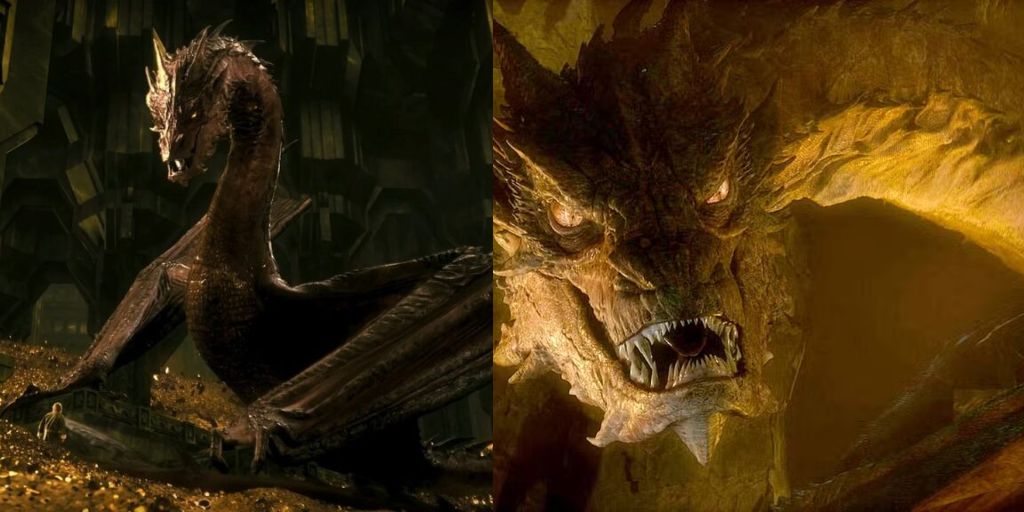
While Glaurung and Ancalagon are essential to the history of Middle-earth, Smaug is arguably the most famous of all Tolkien’s dragons. He is the primary antagonist in The Hobbit and is remembered not only for his physical prowess but also for his sharp wit and cunning mind.
Smaug’s story begins when he attacks the Lonely Mountain, the home of the dwarf king Thrór. After the War of the Dwarves and Dragons had weakened the dwarves, Smaug saw an opportunity to claim their immense treasure for himself.
He destroyed the nearby human city of Dale, drove the dwarves from their mountain, and made their hoard his own. For over a century, Smaug slept atop his stolen wealth, undisturbed until a group of dwarves, led by Thorin Oakenshield, decided to reclaim their kingdom.
With the help of Bilbo Baggins, a hobbit with no experience in thievery but a good deal of luck, the company set out to retrieve their homeland from the dragon.
What makes Smaug unique in Tolkien’s works is his intelligence and personality. Unlike many dragons in literature, who are portrayed as mindless beasts, Smaug is highly articulate, capable of reasoning, and even attempts to manipulate Bilbo during their famous conversation in Lonely Mountain.
Smaug deduces Bilbo’s involvement with the men of Laketown and tries to sow seeds of doubt in the hobbit’s mind about Thorin’s loyalty. This interaction shows Smaug as not just a powerful force of destruction but also a cunning adversary capable of psychological warfare.
Though Smaug is ultimately slain by Bard the Bowman, his legacy lingers throughout the rest of The Hobbit. The “dragon sickness” that surrounds his hoard leads men, elves, dwarves, and orcs to fight over the treasure, causing more conflict even after Smaug’s death. His presence, both in life and after, symbolizes the destructive power of greed and the corrupting influence of wealth.
Smaug’s role in The Hobbit has cemented him as one of the greatest dragons in fantasy literature. His intelligence, arrogance, and overwhelming power make him a formidable foe, while his personality sets him apart from many of the more stereotypical dragons in myth and legend.
Tolkien’s Legacy: How His Dragons Shaped Modern Fantasy
Tolkien’s dragons are much more than simple beasts; they are complex, intelligent creatures that play significant roles in the history of Middle-earth. From Ancalagon’s massive size and destructive power to Smaug’s cunning and psychological manipulation, each dragon brings something unique to Tolkien’s world.
These creatures are not just obstacles for heroes to overcome but reflections of deeper themes, such as the corrupting nature of greed, the cyclical nature of history, and the destructive force of unchecked power.
Tolkien’s dragons have had a profound influence on the fantasy genre. Many modern writers, such as George R.R. Martin in A Song of Ice and Fire or Christopher Paolini in Eragon, have drawn inspiration from Tolkien’s portrayal of dragons.
By giving his dragons intelligence, personality, and unique motivations, Tolkien broke away from the traditional depiction of dragons as mere monsters. He set the standard for how dragons are written in fantasy literature today.
In this way, the legacy of Tolkien’s dragons extends far beyond the pages of The Hobbit, The Silmarillion, and The Lord of the Rings. They have become archetypes in their own right, symbols of power, greed, and destruction that continue to inspire readers and writers alike.