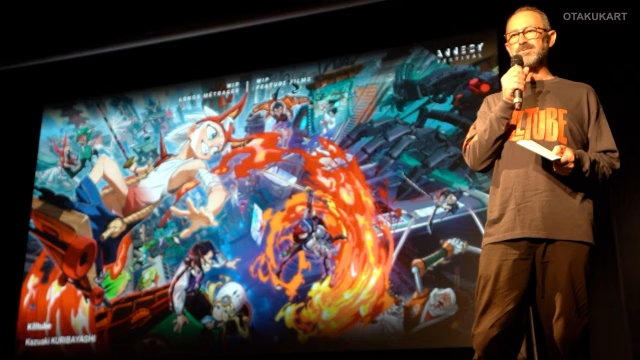
Shinichiro Watanabe, the well-known creator behind the legendary anime Cowboy Bebop, has shared some surprising thoughts about his latest project, Lazarus. The new anime, which has strong financial backing from American producers, might seem like a dream project from the outside.
With more money on the table, many people would assume production would run smoothly and with fewer limitations. However, Watanabe has explained that in reality, the higher budget brought more problems rather than solving them.
Lazarus is a high-profile anime project with ambitious goals. It features cutting-edge animation, a unique blend of science fiction and action, and a creative team made up of both Japanese and international talent.
Given Watanabe’s reputation for delivering stylish and memorable works, expectations for Lazarus have been very high. Yet during recent discussions about the production process, he admitted that working with a bigger budget and overseas investors created more difficulties than anticipated.
According to Watanabe, one of the main challenges came from the extra oversight and approval steps that came with American funding. Because the investors wanted to make sure their money was being used effectively, they imposed additional layers of management and decision-making. This slowed down the creative process and added pressure to meet different expectations from various sides. Watanabe explained that these outside opinions sometimes clashed with his vision for the series, forcing compromises that wouldn’t have been necessary on a smaller project.

Cowboy Bebop Creator Says Bigger Budget Made Lazarus Anime Harder to Make
Another unexpected issue was the complexity of communication between international teams. While global collaboration can bring fresh ideas, it also means dealing with time zone differences, language barriers, and cultural misunderstandings.
For Lazarus, these problems were made worse by the fact that there were more stakeholders than usual. With so many voices in the room, the decision-making process became slower and more complicated. Watanabe noted that this sometimes made it difficult to keep the production on schedule and maintain the original creative direction.
He also pointed out that while a larger budget allows for more ambitious animation and action sequences, it can lead to overcomplication. When money is less of a limiting factor, teams may feel tempted to push for bigger, flashier scenes, even if they take longer to produce and don’t necessarily improve the storytelling.
Also Read: Anime’s Rise in the West: Why Fans Are Moving Beyond Disney
Watanabe stressed that creative restraint is important and that too much freedom can sometimes harm the focus of a project.
Lazarus is still one of the most anticipated anime releases in recent years, partly because of Watanabe’s strong track record and partly because of the unique combination of talent involved. The series is set in a near-future world filled with mystery, intense action, and philosophical themes, much like Watanabe’s earlier works. Its style, pacing, and tone are expected to carry his signature touch, even if the production process has been more challenging than usual.
Watanabe’s comments highlight a broader issue in the anime industry. In recent years, more overseas companies have been investing in Japanese animation, leading to bigger budgets and global releases. While this has opened doors for more ambitious projects, it has also introduced new creative and logistical problems. Producers now have to balance artistic freedom with the expectations of international investors who may not fully understand the unique culture and process of anime production.
Shinichiro Watanabe Shares How High Funding Created Unexpected Problems for Lazarus
Despite these difficulties, Watanabe remains committed to delivering a finished product that lives up to both his vision and the fans’ expectations. He acknowledged that the road to completing Lazarus has been rough, but he also suggested that overcoming these challenges has pushed him and his team to find creative solutions.
Even though the extra funding made things more complicated, it also gave the team access to better technology, more staff, and higher-quality resources than they might have had otherwise.
Fans of Cowboy Bebop, Samurai Champloo, and Watanabe’s other works are eager to see how these behind-the-scenes struggles will shape the final version of Lazarus. Some are curious if the issues caused by the high budget will be visible in the finished anime, or if the team will manage to turn those problems into strengths.

For many, Watanabe’s honesty about the difficulties is refreshing, as it gives a rare look into the realities of modern anime production.
While no exact release date for Lazarus has been confirmed yet, the project continues to generate excitement. Watanabe’s involvement alone is enough to draw attention, but the mix of international collaboration, ambitious visuals, and thought-provoking storytelling is likely to make it a standout title when it finally premieres.
Whether the high budget will ultimately be seen as a blessing or a curse remains to be seen, but one thing is certain, Lazarus will be one of the most closely watched anime of its release year.