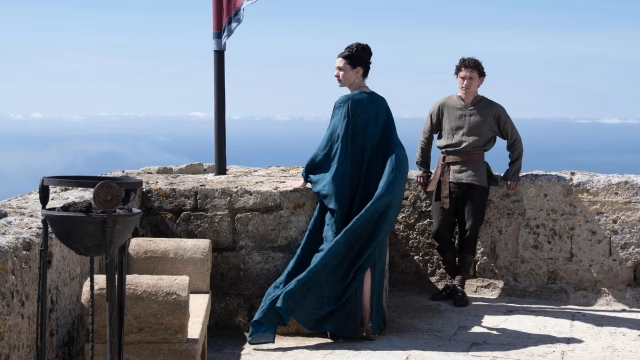
The film unfolds on the small Italian island of Pantelleria, where Marianne Lane, a famous rock singer recovering from throat surgery, enjoys a quiet holiday with her filmmaker boyfriend, Paul De Smedt.
Their intimacy is initially undisturbed until the intrusion of Marianne’s former lover, Harry Hawkes, and his daughter, Penelope, sparks a chain of events fueled by jealousy, betrayal, and suppressed desires.
Tensions rise quickly as Harry revives old flames with Marianne while simultaneously creating friction with Paul. Penelope’s provocative presence adds to the charged atmosphere, complicating the relationships further.
The rivalry between Paul and Harry culminates in a violent confrontation by the pool, where Harry drowns after Paul holds him underwater in a moment that is left ambiguous: was it accidental or intentional? Paul’s subsequent attempt to revive Harry fails, forcing him to leave Harry’s body submerged.
Also read: Revolutionary Road Ending Explained: Why the Tragic Finale Still Haunts Audiences
The mystery deepens as the police investigate, distracted by larger issues such as refugee landings, allowing the villa inhabitants to provide conflicting accounts.
Marianne pushes the narrative that an unknown intruder might be responsible, deflecting suspicion from Paul. The island’s serene beauty thus contrasts sharply with the darkness of secrets and lies bubbling beneath the surface.
Morality and Manipulation: Marianne’s Choices and the Mystery of Penelope
Marianne’s character offers one of the film’s central tensions. Though she professes love for Harry, she also claims loyalty to Paul, embodying a fractured vulnerability.
Her silence due to surgery symbolizes the limited communication and hidden truths she harbors. When the police question the occupants, Marianne’s willingness to shift blame onto external forces, such as the refugees nearby, raises uncomfortable ethical questions about self-preservation and scapegoating.
Penelope remains the most mysterious figure. Officially Harry’s daughter, it is revealed she is younger than she claims and fully fluent in Italian, despite allowing other characters to struggle with the language.
Her ambiguous actions, especially her quiet observation of the heated conflicts and her interactions with Paul, create an unsettling presence.

At the film’s conclusion, as Penelope departs the island, she delivers a cryptic remark echoing Marianne’s own words, provoking a visible reaction. Marianne’s slap conveys deep emotional turmoil, while Penelope’s tears during her departure underscore her complex role as both observer and catalyst.
The film leaves Penelope’s intentions and knowledge open to interpretation, inviting viewers to question her true impact on the events.
The Subtle Tensions Beneath Desire and Power
Beyond the central murder mystery and relationship drama, the film explores themes of desire, power play, and the fragile nature of control. Harry’s confident, domineering personality contrasts with Paul’s more subdued demeanor, yet both men reveal vulnerabilities in their battle for Marianne’s affection and emotional dominance.
Director Luca Guadagnino uses the island’s isolation to amplify the characters’ claustrophobia, both physical and emotional. Marianne’s voicelessness intensifies the lack of clear communication, even as the characters’ desires speak loudly in their behaviors.
The pool serves as a symbolic setting where boundaries dissolve between friends and lovers, between aggression and intimacy.
The unresolved nature of the characters’ interactions leaves the film’s impact lingering. The question of who truly controls the narrative, or who holds power in this isolated paradise, remains elusive. The film suggests that beneath the glamorous exterior lies a fragile web of secrets, jealousy, and shifting loyalties.
The finale of A Bigger Splash refuses a neat resolution, instead offering a mosaic of tensions that evoke both the personal cost of desire and the moral ambiguity of survival.
Marianne, Paul, Harry, and Penelope are caught in a delicate dance of vulnerability and manipulation, the ripples of which extend far beyond their sunlit island refuge.
This psychological drama gains depth from its rich character work and atmospheric direction, leaving viewers to piece together the implications long after the credits roll.
Also read: Blue Valentine Ending Explained: Heartbreak, Fireworks, and the Final Goodbye That Divides Audiences