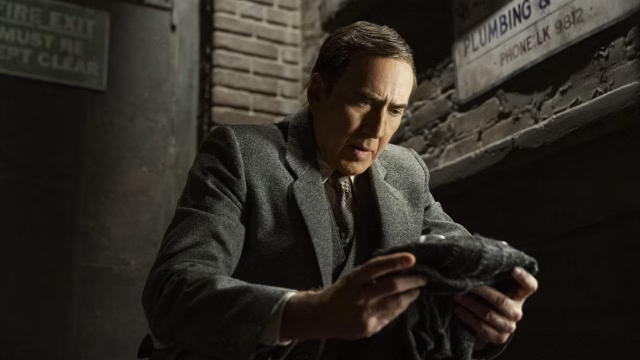
Nile Jarvis, the charismatic and manipulative billionaire at the centre of The Beast in Me, seemed untouchable for most of the series. His wealth, connections, and calculated charm allowed him to control the narrative around his family and evade suspicion for years.
Yet, as Aggie’s investigation deepened and the truth about Madison’s disappearance came to light, Nile’s carefully constructed world began to crumble.
The breaking point came when Nina, Nile’s pregnant sister-in-law, secretly recorded his confession to the murders of Madison and Teddy Fenig, then handed the evidence to the authorities.
Nile was arrested in a dramatic scene during a press conference, where FBI agents stormed in and took him away. He pleaded no contest to all charges, including the murders of Madison, Teddy Fenig, and FBI agent Brian Abbott, and was sentenced to three consecutive life sentences with no chance of parole.
This moment marked the collapse of Nile’s public empire and the end of his ability to manipulate the system. For viewers, it was a satisfying resolution to Aggie’s quest for truth, but the story did not stop there. Nile’s public downfall was only the beginning of a deeper reckoning.
Justice Served, But Not By the System
Even after Nile’s arrest, the series refused to offer a clean resolution. Nile’s uncle, Rick, determined to protect the family’s legacy and prevent Nile from revealing more secrets, orchestrated his nephew’s murder in prison.
Nile was stabbed to death by another inmate, an act that eliminated any further threat Nile posed to the Jarvis family’s reputation.
Rick’s actions underscored the show’s central theme: the corrupting influence of power and the lengths to which the wealthy will go to protect their own. Nile’s death was not the result of the justice system, but of the same cycle of violence and cover-ups that he had exploited for years.
Also Read: 2025 MAMA AWARDS Releases Statement Following Hong Kong Fire, Cancels Red Carpet
The series makes it clear that Nile paid for his crimes, but the manner of his death highlights the flaws and corruption that define the system he manipulated.
The Social Commentary: Justice, Power, and Legacy
The Beast in Me uses Nile’s downfall to explore broader social issues, particularly the way wealth and power can shield the guilty from true justice. Nile’s story is not just about one man’s crimes, but about the generational rot and systemic corruption that allow such figures to thrive.
The show critiques the way the justice system often fails to hold the powerful accountable, and how families like the Jarvises use intimidation and violence to maintain their influence.

Nile’s fate also raises questions about the nature of justice itself. While he was punished for his crimes, the manner of his death underscores the idea that true justice is often messy and incomplete, especially when the powerful protect their own. The show’s final message is that justice can be served, but it is rarely straightforward.
The Emotional Impact: Aggie’s Redemption and the Lingering Darkness
Aggie, the grieving writer at the heart of the series, undergoes a profound transformation as she confronts the truth about Nile and her own complicity in his crimes. She begins the series paralysed by grief and rage, but by the end, she has reclaimed her voice and published her book, The Beast in Me.
Yet, the series does not offer a simple redemption arc. Aggie is aware of her own darker impulses and the role she played in the story she tells.
Nile’s death in prison signals the final collapse of the Jarvis empire, but the lingering question remains: does the darkness pass on to the next generation? The show leaves viewers with a complex view of justice, one that acknowledges the cost of holding the powerful accountable and the emotional toll it takes on those left behind.
The Cultural Resonance: A Story for Our Times
The Beast in Me resonates with contemporary audiences because it reflects the real-world struggles of holding the wealthy and powerful accountable. Nile Jarvis is not just a fictional villain, but a symbol of the real-life figures who use their influence to evade justice.
The show’s exploration of generational rot, systemic corruption, and the emotional toll of seeking justice makes it a powerful commentary on the state of our society.
In the end, Nile Jarvis’ downfall is a cautionary tale about the dangers of unchecked power and the complexities of justice. The Beast in Me reminds us that while justice can be served, it is rarely simple, and the cost of holding the powerful accountable is often high.
Also Read: Hyun Bin and Jung Woo Sung Confirmed for Variety Show The Manager