Season 5 builds toward “Chapter Eight: The Rightside Up,” the series finale that doubles as a last stand against Vecna and the Upside Down itself.
After the prior episodes leave Hawkins fractured and partially merged with the other dimension, the finale opens with Henry/Vecna using kidnapped kids as psychic amplifiers to drag a deeper layer of the Upside Down, nicknamed the Abyss, fully into the town.
Netflix’s Tudum breakdown and detailed recaps all agree that this is the closest he has come to making his warped vision permanent.
To stop him, the characters split into three coordinated teams. Eleven, backed by Max and fellow lab escapee Kali, connects to Vecna through a boosted sensory tank, aiming to sever his hold on the children and weaken his focus.
Steve, Nancy, Robin, Lucas, Dustin, Jonathan, and others push physically into the Abyss via a twisted radio tower, trying to reach the grotesque “Pain Tree” where the kids hang in vine cocoons. Meanwhile, Hopper, Joyce, and Murray carry a nuclear device into the Upside Down, intending to destroy its center once everyone else is clear.
The Pain Tree turns out to be more than a set piece. According to Netflix and Variety, it houses the Mind Flayer’s true body, a vast spider‑like entity whose roots bind the Upside Down together. When Nancy shoots a pulsing chunk of exotic matter on the trunk, she destabilizes the dimension itself, triggering a cascading collapse.
On the ground, the group hacks at limbs, sets fire to tendrils, and fights off creatures while trying to free the children before the place implodes.
Will’s long-running connection finally pays off here. Because part of him is still tuned to the Mind Flayer, he and Eleven manage to briefly hijack Vecna’s movements, pinning him inside the creature’s psychic interior long enough for her to impale him on jagged roots.
Variety and TVLine point out that this sequence clarifies their dynamic: Henry reshaped the Mind Flayer as his weapon, not the other way around, so killing him and the monster’s physical form together is the only way to stop their shared plan.
By the time Hopper arms the bomb, Vecna’s body is torn apart, the Mind Flayer is crumbling, and the Upside Down has begun to fold in on itself. The detonation triggers a bright shockwave across both dimensions, causing rifts over Hawkins to seal and the corrupted sky to clear.
Also read: Bacon and Sedgwick’s Netflix Rom-Com Ignites Holiday Streaming Buzz with Real-Life Sparks
The show finally moves beyond “gate closed for now” and treats this as a permanent structural collapse, a point underlined in official explainers and critic roundups.
“You Have To Let Me Go”: Eleven’s Fate, Will’s Future, And That Last Shot
The emotional heart of the finale sits not in the spectacle, but in the choices that follow. During the climax, Eleven gets knocked out of Vecna’s mind earlier than planned and realizes the bomb’s countdown has started while he still clings to life.
Instead of escaping, she forces herself physically into the Abyss, standing inside the collapsing Mind Flayer as Hopper’s team retreats.
TVLine, the New York Times, and Cosmopolitan all highlight a brief but crucial exchange where Eleven reaches Mike and Will telepathically from within the chaos.
She tells them she is staying to end the cycle that began in Brenner’s lab, reasoning that if the Upside Down remains as a power source, someone else will eventually pick up Brenner’s work and start hurting children again.
Her choice reframes the story: it is not just about killing monsters but about shutting down the system that made her a weapon.
When the bomb detonates, we see a montage of the Pain Tree exploding, the Mind Flayer’s limbs disintegrating, and portals snapping shut across Hawkins. Eleven stands in a blinding void as the dimension tears itself apart, then vanishes.

To her friends, who stagger out on the other side of what used to be a gate, it looks like she died in the blast, and later recaps describe how the town holds a memorial honoring her alongside other victims.
The final scenes, however, leave wiggle room. A restored yet scarred Hawkins appears, with fenced-off scorch marks where rifts once opened and residents quietly rebuilding.
The kids gather around a Dungeons & Dragons table again, mirroring the pilot, only now they talk frankly about loss, queer identity, and what comes after saving the world.
Variety’s coverage notes that Will gets a key moment here, telling Mike that he refused to follow Vecna’s path despite feeling the same pull, turning his survival into a deliberate choice rather than an accident.
Then there is the last shot. As the group finishes a campaign dedicated to Eleven, Will feels a faint tingle on the back of his neck, similar to his old Mind Flayer sense but gentler.
A few glowing particles drift past the window, yet they do not behave like the Upside Down spores seen in earlier seasons; instead, they shimmer briefly and vanish. USA Today and PopRant both frame this as the Duffers’ compromise: the Upside Down is gone, but some trace of Eleven or her power might linger, leaving fans room to imagine where she ended up.
After The Credits: Why This Ending Feels Final But Still Sparks Debate
Outside the story, the Season 5 ending carries big implications for Netflix, the franchise, and long‑running fan debates. Netflix’s Tudum article emphasizes that the creative team always wanted a five‑season arc, and the finale sticks to that plan instead of teasing a direct sequel series.
Rotten Tomatoes’ Season 5 page shows strong scores, with critics praising the choice to prioritize character closure over endless spin‑off hooks.
Variety and USA Today highlight how the epilogues give nearly every core character a small but meaningful beat. Hopper and Joyce get quiet domestic scenes that finally treat them as parents first, survivors second. Lucas and Max share moments that acknowledge her trauma without pretending it disappears.
Dustin and Steve settle into older‑brother rhythms that feel earned after years of growth. Rather than chasing one last twist, the finale leans into the idea that surviving horror can mean learning how to keep living with it.
There is still room for disagreement. Some reviewers and fan threads argue that leaving Eleven’s fate ambiguous hedges on the promise of real sacrifice, especially after earlier “fake‑out” deaths in the series.
Others, including New York Times critics, counter that the show has always been as much about myth as about realism, and that letting her slip into something like legend fits her arc from lab experiment to self-chosen guardian.
Variety’s analysis of Will’s story also points out that the ending lets a queer kid from small‑town Indiana grow into adulthood without burying him, which feels significant given TV’s messy history with characters like him.
Business-wise, the finale leaves plenty of room for prequels, anthology offshoots, or one-off specials without demanding them.
With the Upside Down gone and Hawkins no longer actively tearing open, any future project would likely focus on earlier timelines, alternate perspectives, or completely different characters in the same universe.
Netflix has not officially confirmed any direct follow-up yet, but trade reporting around the finale notes that the streamer sees Stranger Things as a key brand, so additional stories of some kind seem likely.
Taken together, the Season 5 ending does what many fans hoped and feared at the same time. It closes the book on Hawkins’ war with the Upside Down, pays off Vecna’s threat in a way that feels permanent, and lets its heroes grow up instead of staying frozen as eternal kids on bikes.
At the same time, a few glowing particles outside a bedroom window keep the door cracked, just enough for memories, headcanon, and maybe someday, a return trip from wherever Eleven went when she decided to finally break the cycle.
Also read: Jason Momoa’s Decade-Old Crime Gem Cracks Netflix Global Top 10, Sparks Binge Frenzy
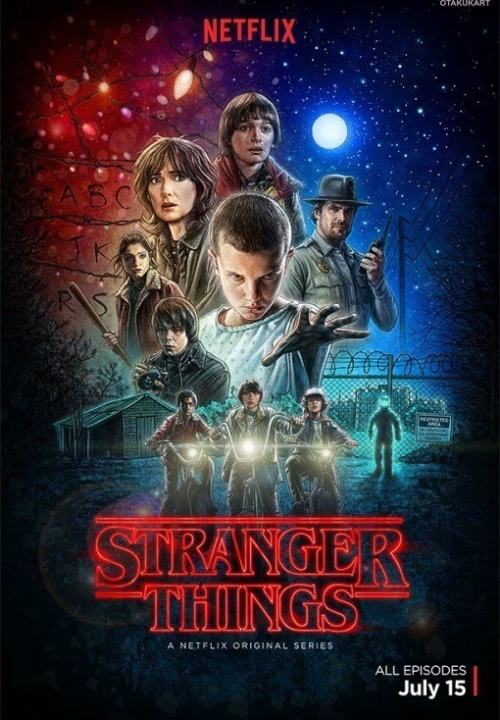
| Premiere Date | July 15, 2016 |
|---|---|
| Network / Service | Netflix |
| Creator | Matt Duffer, Ross Duffer |