
Psychological horror in video games owes much of its modern identity to Silent Hill. First released in 1999, the title redefined survival horror by shifting the focus from jump scares to atmosphere, symbolism, and deeply personal fear. Its legacy continues to influence developers across generations.
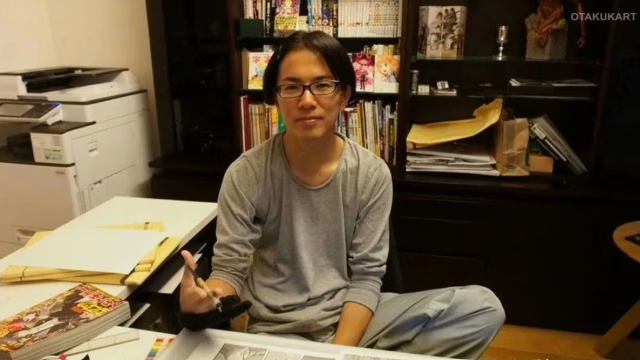
During Lucca Comics & Games, we had the opportunity to speak with Keiichiro Toyama, the creator of Silent Hill. In our conversation, he discussed the psychological foundations of Japanese horror, the creative philosophy behind his projects, and his perspective on the evolving landscape of the game industry.
The following interview was conducted with the assistance of an interpreter and has been lightly edited for clarity.
Oliver: Japanese horror has a distinct identity across film, literature, and video games. What core qualities allowed it to resonate globally?
Keiichiro Toyama: Compared to earlier decades, many traditional mysteries have been explained, which may lessen their impact.
However, what continues to resonate is the psychological dimension, the exploration of human nature. Japanese horror often focuses on the darker aspects of the human heart and the hidden anxieties within us. That introspection remains compelling worldwide.
Oliver: Were classic Japanese literary works an influence on your games?
Keiichiro Toyama: I was born in 1970, so I grew up immersed in manga and television. Bookstores were also an important part of my childhood. I sometimes watched or read material that was probably intended for older audiences, but curiosity drew me to it.
Creatively, I was particularly influenced by artists such as Kazuo Umezu, known for The Drifting Classroom, and Hideshi Hino, creator of Panorama of Hell. Their unsettling imagery and psychological tension left a lasting impression on me.
Oliver: The indie horror scene today often features shorter games with strong narrative concepts. Has the genre shifted in recent years?
Keiichiro Toyama: Independent horror titles tend to prioritize originality over scale or technical perfection. Length and production volume are less important than a distinctive idea. This model benefits younger developers working with limited budgets, allowing them to establish a presence in the market more easily.
Oliver: What can horror communicate that other genres cannot?
Keiichiro Toyama: Horror is fundamentally tied to the concept of death. Every person has some relationship with that idea. There is a universal curiosity about mortality, and the genre provides a way to confront it indirectly.
Oliver: You have also directed action-oriented projects such as Gravity Rush. How did your creative process differ from your horror titles?
Keiichiro Toyama: My approach remains consistent. Whether horror or action, the protagonist typically enters an unfamiliar world. Exploration becomes central, driven by a mix of curiosity and apprehension. That emotional balance is something I carry across genres.
Oliver: Game development requires coordination among many disciplines. What enables a team to produce cohesive work?
Keiichiro Toyama: I try to avoid over-defining every detail of the process. Instead, I concentrate on establishing a strong core concept. Once that foundation is clear, team members apply their individual strengths. When everyone understands the central idea, coherence develops organically.
Oliver: What message would you share with overseas fans and aspiring developers influenced by your work?
Keiichiro Toyama: When I began my career, I admired and learned from those already established in the field. That respect motivated me to improve. If newer generations now draw inspiration from my work, that creates a meaningful connection. I encourage them to continue creating. I look forward to seeing how they evolve.
We extend our appreciation to Keiichiro Toyama for taking the time to speak with us during his appearance at Lucca Comics & Games. Amid the convention’s wide array of programming, the discussion offered valuable insight into the creative mindset behind one of horror gaming’s most influential figures.