In a significant legal development that has closed a dark chapter for the K-hip-hop scene, rapper B-Free (real name Choi Sung-ho, 40) has been officially sentenced to a prison term of one year and four months.
On January 2, 2026, the Seoul High Court upheld the original verdict from his initial trial, dismissing his appeal and confirming that the rapper must face incarceration for an assault that left a victim with permanent visual impairment.
The Violent Confrontation and Injuries
The sentencing follows a violent incident that occurred in the early morning hours of June 18, 2024, at an apartment complex in Jung-gu, Seoul.
B-Free was reportedly involved in a loud dispute with a security guard over an entrance barrier when a resident living on the first floor complained about the noise.
Enraged by the protest, B-Free called the resident outside and launched a physical attack.
The victim was struck in the face with such force that they fell to the ground, sustaining a triangular facial fracture and lacerations. Most tragically, the assault caused traumatic optic neuropathy in the victim’s right eye.
Also Read: Controversy and Defense: BTS Jin’s Actions Toward Jungkook Stir Intense Debate
While the defense argued the injuries might improve, medical assessments indicated a high probability of permanent visual impairment, requiring over eight weeks of intensive medical treatment.
A History of Violence and Legal Recurrence
The court’s decision to impose a prison sentence was heavily influenced by B-Free’s extensive criminal record. The rapper has six prior convictions, many of which are related to violence.
Notably, he committed this latest assault while already on trial for a similar charge, demonstrating what the court described as a “high possibility of recidivism” and a blatant disregard for the law.
During the appeal, the prosecution sought to upgrade the charge to “serious injury,” while B-Free sought a lighter sentence by citing his self-composed lyrics in the song “Magic Hands,” where he pledged to refrain from violence.
However, the appellate court dismissed both arguments, ruling that the initial sentence of 16 months was within a reasonable scope of discretion given the severity of the victim’s disability and B-Free’s unpitying attitude.
A Legacy of Controversy: The BTS Connection
For many K-pop fans, the name B-Free is synonymous with one of the most infamous moments in early idol history.
In 2013, during a “KBH HipHop Radio” broadcast, B-Free sparked international outrage by verbally attacking BTS members RM and Suga.
He mocked them for wearing makeup and “selling out” to become idols instead of remaining “pure” rappers.
Despite several half-hearted apologies over the years—often dismissed by fans as opportunistic attempts to gain traction as BTS reached global superstardom—the rapper remained a persona non grata in the mainstream industry.
Also Read: BTS’s V Channels ’90s Nostalgia for Vogue Japan’s February 2026 Cover
This latest prison sentence is being viewed by many as the final “trash taking itself out,” as one netizen put it, marking the end of a career defined more by aggression and controversy than musical contribution.
Final Verdict and Industry Impact
With the Seoul High Court’s ruling on January 2, the legal proceedings have reached their conclusion.
The court emphasized that the victim had repeatedly petitioned for a heavy sentence and refused to accept any settlement offers from the rapper.
As B-Free begins his 16-month prison term, the case serves as a stern reminder of the legal consequences of violence in the industry.
For a figure who once critiqued others for their lack of “hip-hop spirit,” his legacy is now cemented not in music, but in a prison cell.
Fans of the K-pop and K-hip-hop communities have largely welcomed the news, hoping that this serves as a moment of justice for the victim and a permanent deterrent against the pattern of behavior that has plagued B-Free’s career for over a decade.
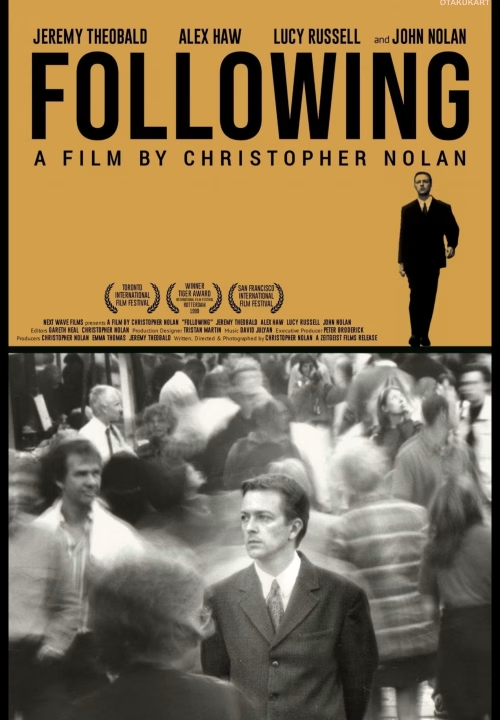
| Release Date | September 12, 1998 |
|---|---|
| Studio | Next Wave Films; Syncopy |
| Director | Christopher Nolan |
| Writer(s) | Christopher Nolan |