

The entertainment world in both Japan and South Korea remains in a state of mourning following the tragic and sudden death of legendary actress Miho Nakayama.
Known globally for her iconic role in the 1995 film Love Letter, Nakayama was a pillar of the Japanese “Hallyu” wave long before the term became a household name.
However, recent reports from April 2026 have shifted the focus from her artistic legacy to the complex legal and financial aftermath of her passing.
Emerging details reveal that her only son has officially declined to inherit her massive estate, which is valued at approximately 18.9 billion KRW (roughly $12.5 million USD).
This decision has sparked significant conversation regarding the heavy financial burdens placed on the heirs of high-net-worth individuals in Japan.
The Financial Weight of a Final Farewell
While the sum of $12.5 million is life-changing for most, the legal realities of Japanese inheritance law present a daunting challenge.
Local media outlets and financial experts speculate that the primary reason for the son’s renunciation is Japan’s notoriously high inheritance tax structure.

In Japan, estates exceeding a certain monetary threshold can be taxed at rates as high as 55%.
Also, the law dictates that this tax must be paid entirely in cash within a strict ten-month window from the start of the inheritance process.
For an heir living abroad- as Nakayama’s son has resided in France since his parents’ divorce- liquidating such a massive estate to cover a multi-million dollar tax bill in a short timeframe is often a logistical and financial nightmare.
The son, born to Nakayama and her ex-husband, has remained largely out of the public eye, but his choice to step away from the fortune highlights a growing trend among the children of Japan’s elite.
By renouncing the inheritance, he avoids the immediate cash-flow crisis that the 55% tax would impose.
This move, while perhaps surprising to those unfamiliar with the region’s fiscal policies, is seen by many as a pragmatic decision to maintain personal financial stability rather than inheriting a “gift” that comes with a massive, immediate debt to the state.
Remembering the Star of Love Letter
The news of the estate follows the heartbreaking discovery of Nakayama on December 6, 2024. The actress was found unconscious in the bathtub of her home in Shibuya, Tokyo.
Following a thorough police investigation and official statements from her management agency, her death was ruled a tragic accident that occurred while she was bathing.
The loss was felt deeply in South Korea, where Nakayama was considered a beloved figure. Her performance in Love Letter, specifically the hauntingly beautiful line “Ogenki desu ka?” (How are you?), remains one of the most famous moments in Asian cinema history.
She also recently endeared herself to younger Korean audiences through her work in the 2017 film Butterfly Sleep.
As the legal proceedings conclude, fans are choosing to remember Nakayama not for the billions she left behind, but for the emotional depth she brought to the screen.
Her agency expressed the collective grief of the industry, while reports continue to highlight the “beloved star” who passed away far too soon.
The decision by her son to turn down the $12.5 million ensures that her financial affairs will be handled by the state or designated executors, allowing him to grieve privately without the looming shadow of a tax crisis.
As one reporter noted, “the actress’s son has declined to inherit the estate, valued at around ₩18.9 billion KRW,” a statement that marks the somber end to a story of a woman who was worth far more than her material wealth to millions of fans across Asia.
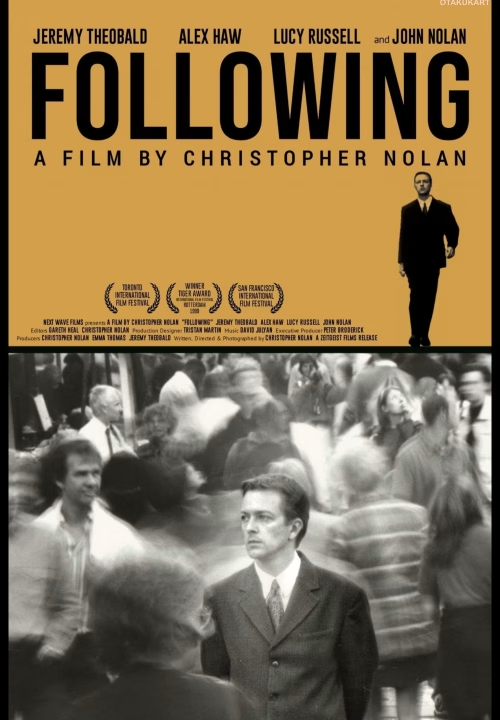
| Release Date | September 12, 1998 |
|---|---|
| Studio | Next Wave Films; Syncopy |
| Director | Christopher Nolan |
| Writer(s) | Christopher Nolan |