
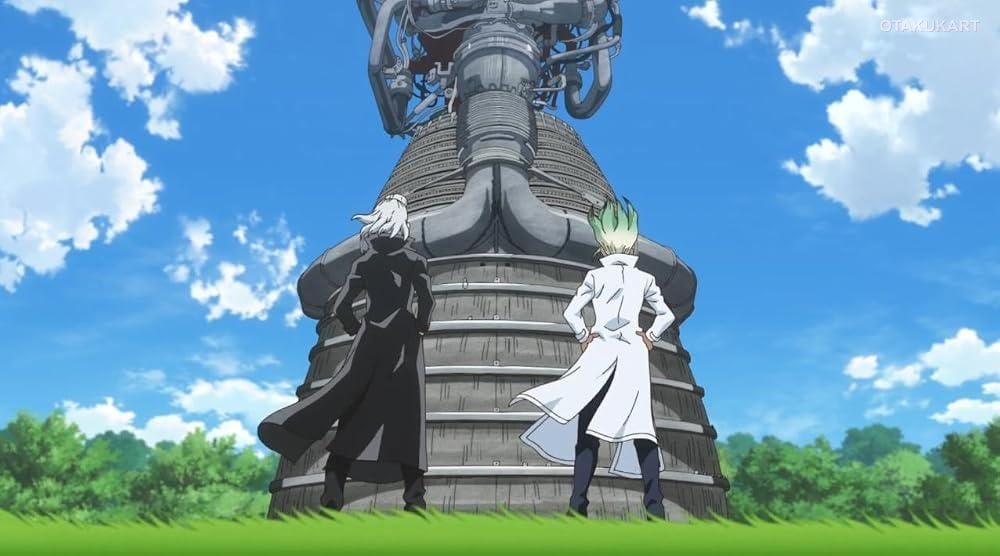
The Dr. STONE anime’s scientific storytelling required more than adapting the inventions from Riichiro Inagaki and Boichi’s manga. The production team also had to research how complex machinery behaves in the real world, particularly when Senku Ishigami and the Kingdom of Science began working toward spaceflight.
A behind-the-scenes interview in Chikyū no Arukikata: Anime Dr. STONE reveals that producer Shūsuke Katagiri and director Shūhei Matsushita paid particular attention to the rocket-launch sequences. Rather than treating ignition and liftoff as simple animated spectacle, the staff investigated the individual stages of an actual rocket launch, including exhaust expansion, flame colors, smoke, and the separation of rocket components.
The interview offers a closer look at the production research behind one of the anime’s most ambitious scientific developments.
Dr. STONE’s Rocket Launch Sequences Were Based on Real-World Research
Katagiri explained that the team investigated how a rocket launch progresses, beginning with engine ignition and the expansion of exhaust before the vehicle starts ascending. They also studied how different components separate during flight to ensure the sequence maintained a convincing order of events.
The research extended to visual details that could easily be overlooked in an ordinary animated production. The staff consulted scientific supervisors about the appearance of rocket flames, their changing colors, and the smoke produced during ignition.
Matsushita noted that determining these details required considerable research. The team had to establish whether smoke would appear at particular stages, what color the flames should be, and how the visual effects should change as the rocket gained altitude.
These details were important because the production team wanted the launch to feel like a sequence of connected physical events rather than an exaggerated explosion followed by liftoff.
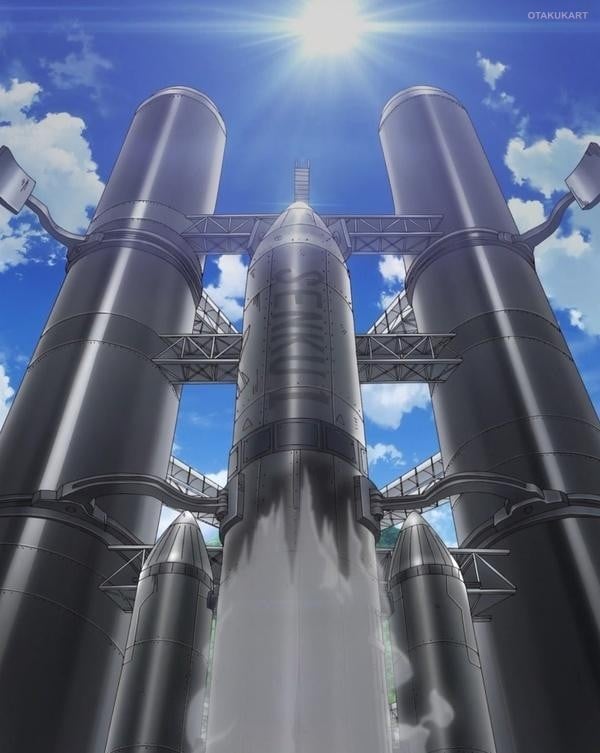
The Team Also Checked Rocket Construction and Testing Schedules
The research was not limited to what audiences would see during liftoff. Katagiri and Matsushita also examined the rocket’s construction and testing schedule to ensure that the development process depicted in the anime followed a believable progression.
According to the guidebook interview, the production team consulted specialists to check whether the activities shown on the fictional development calendar made sense. The schedule included specific tasks and testing stages rather than serving as decorative background material.
The staff also discussed what would happen if a launch failed. Senku and his team would have to return to testing and attempt another launch, making repeated experimentation an important part of the process.
This attention to detail reflects how Dr. STONE approaches scientific progress. The characters do not simply invent something and immediately succeed. Their achievements come through experimentation, failures, adjustments, and improvements.
Fireworks Research Also Required Scientific Supervision
The same interview reveals that the production team applied similar research to the fireworks scenes on Treasure Island.
The staff considered which minerals could realistically be obtained from the island and what colors those materials could produce when used in fireworks. Rather than choosing colors purely for visual appeal, they considered the resources available to Senku and his companions at that point in the story.
The team also discussed using zeolite, a mineral that can absorb moisture, to help create sufficiently dry conditions for producing fireworks. These details demonstrate how the setting’s available resources influenced the scientific crafts shown in the anime.
Director Matsushita has discussed this broader approach in a separate interview with MANTANWEB. He explained that even rocket flame colors depend on the fuel being used, requiring the team to consult specialists when adapting scientific processes for animation.