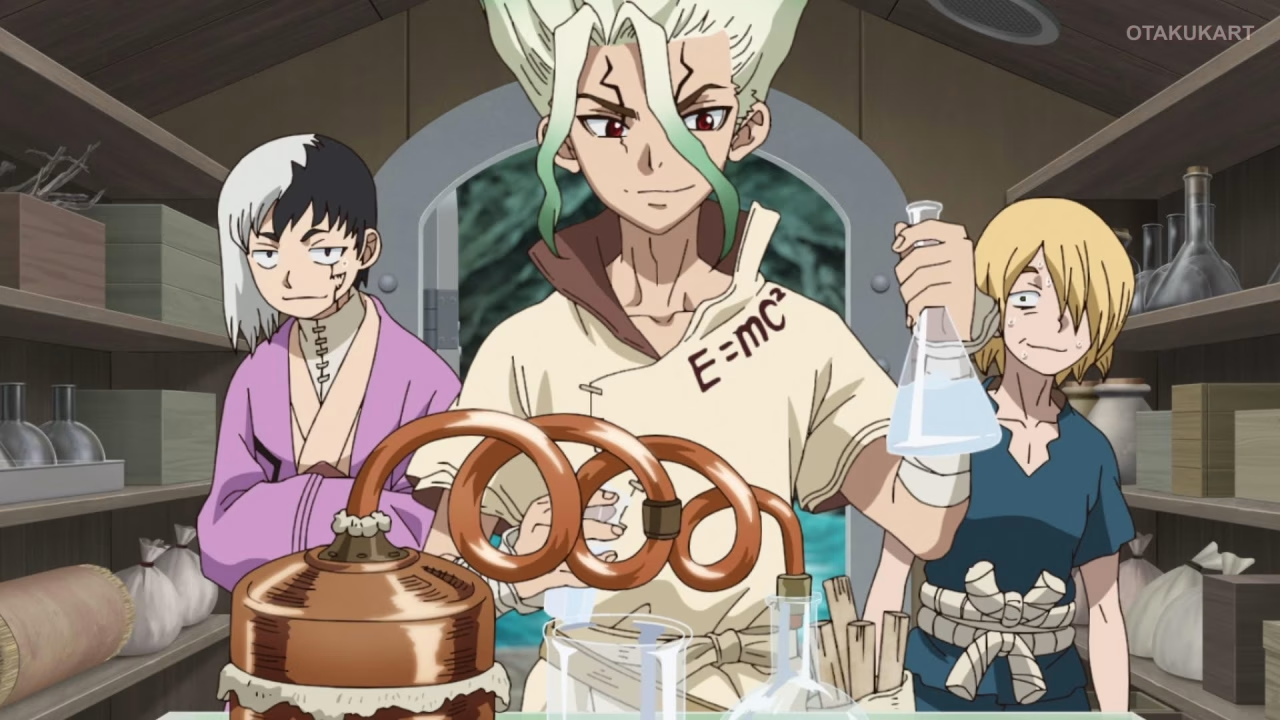
The production team behind Dr. STONE paid attention to scientific details that viewers might easily overlook, but there were occasions when making an experiment completely reproducible was not the goal. Producer Shūsuke Katagiri has revealed that the anime deliberately avoided showing exact ingredient quantities for certain scientific crafts because viewers could potentially recreate them using the information shown on screen.
The detail comes from a joint interview with director Shūhei Matsushita and producer Katagiri in the Japanese guidebook Chikyū no Arukikata: Anime Dr. STONE. The interview, featured on printed page 156, offers an interesting look at how the production team approached the series’ scientific demonstrations without turning every animated sequence into a complete practical tutorial.
Dr. STONE Staff Deliberately Avoided Showing Exact Measurements for Some Science Crafts
During the discussion, Matsushita explained that the team wanted the scientific crafts to look believable without making their presentation excessively realistic. Katagiri added that he had repeatedly emphasized the importance of realism throughout the production, but there were limits to how far the anime could take that approach.
According to Katagiri, showing scientifically accurate procedures was not necessarily a problem. However, providing precise ingredient quantities could make certain creations genuinely reproducible. The team therefore decided to communicate some processes through illustrations rather than displaying exact numerical measurements.
Matsushita also mentioned that the quantities shown for certain creations were closer to the level of a cocktail recipe. Katagiri noted that some viewers might actually want to try making these creations themselves, which made the decision particularly relevant.
This approach allowed the anime to retain its scientific foundation while avoiding the need to provide exact measurements for every experiment.
Vanilla-Making and Platinum Experiments Required Repeated Scientific Checks
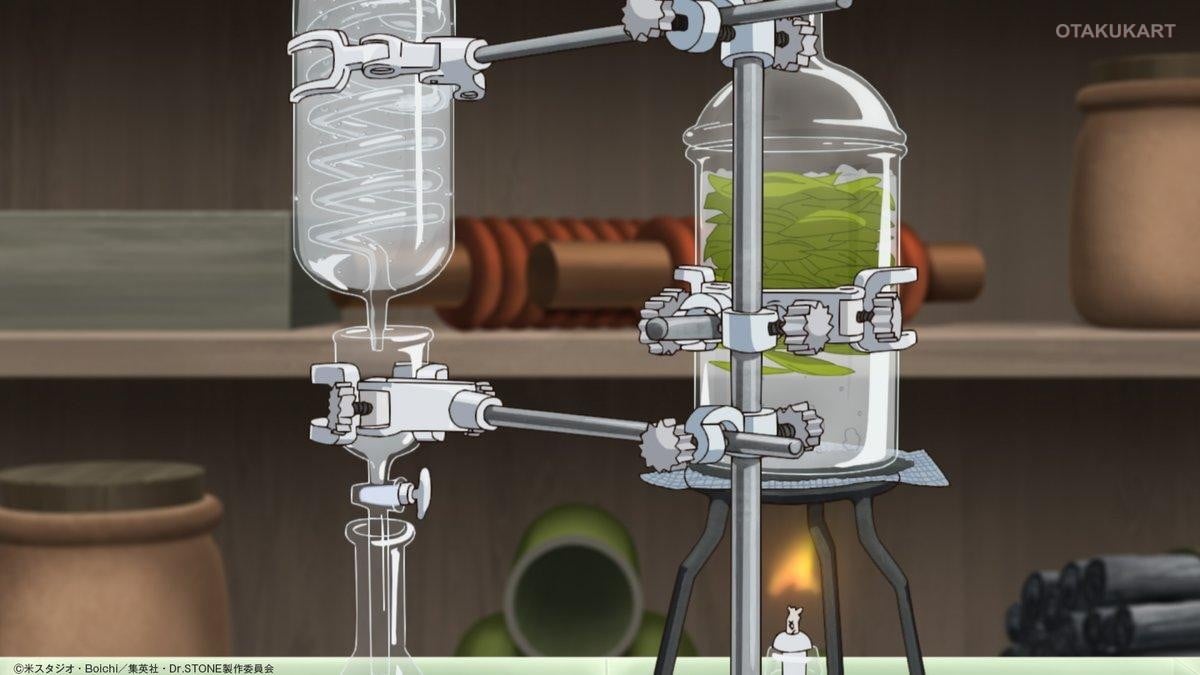
The interview also highlights how much work went into making individual scientific crafts look convincing. One particularly challenging example was the vanilla-making sequence, which required repeated communication between the animation team and the production’s scientific supervisors.
Katagiri explained that the team first developed the scene’s composition and sent it for scientific review. The supervisors then pointed out details that needed correction, including the appearance and colors of the equipment. The production team repeatedly revised the visuals before reaching a version that accurately represented the intended process.
Another example involved the equipment used to produce nitric acid from platinum-related materials. The staff consulted scientific supervisors about how the chemical reaction should appear, including the color of the flame and the smoke produced during the process.
Katagiri and Matsushita explained that even seemingly minor details required careful consideration. The team discussed whether the smoke should appear slightly yellow, how it would interact with the surrounding liquid, and how the reaction should be represented visually.
These examples demonstrate why Dr. STONE required more than simply drawing characters operating scientific equipment. The production team had to consider the underlying processes while ensuring the finished scenes remained understandable and visually engaging.
How the Production Team Balanced Realism and Entertainment
Beyond individual experiments, the interview reveals a broader philosophy behind the anime’s scientific presentation. The staff wanted viewers to recognize that the inventions followed scientific principles without making every scene feel like a technical manual.
The team also discussed how different environments influenced the anime’s visual design. Matsushita explained that forests in Japan and the Amazon required different vegetation, colors and atmospheric details. The production team researched the locations to make those differences recognizable rather than relying on generic backgrounds.
Katagiri also discussed how the staff used geographical references to make the characters’ journeys believable. The route through South America and the Andes, for example, was designed with attention to the actual geography, with additional transitions used to help viewers follow the journey.
These production details highlight the amount of research behind Dr. STONE. Its scientific appeal comes not only from Senku’s inventions but also from the effort to make the surrounding environments, experiments and everyday activities feel grounded.